• By Kevin E. Noonan

    Federal Circuit SealThe Federal Circuit's Ariosa v. Sequenom decision handed down earlier this summer marked the apex (or nadir, according to your prejudices) of the current trend to limit the scope of patent eligible subject matter.  On Thursday, twelve amicus curiae briefs were filed in support of Sequenom's petition to the full court for rehearing en banc.  We will post on the substance of these briefs in later posts; for now the posts can be accessed here:

    • Twenty-three Law Professors, Kevin E. Noonan Counsel for Amicus Curiaebrief

    • Novartis AG, Corey A. Salsberg, Counsel – brief

    • Jeffrey A. Lefstin and Peter S. Menell, Jeffrey A. Lefstin, Counsel – brief

    • WARF, Marshfield Clinic, and MCIS, Michelle Umbreger, Michael R. Osterhoff and Dan L. Bagatell, Counsel — brief

    • Intellectual Property Owners, Teige P. Sheehan, Counsel – brief

    • Paul Gilbert Cole, Donald L. Zuhn, Counsel – brief

    • New York Intellectual Property Law Association, John D. Murnane, Alicia Russo and Erin J.D. Austin, Counsel – brief

    • Jyant Technologies, Inc., Matthew J. Dowd, Robert A. Gutkin, and  Sushila Channana, Counsel – brief

    • Biotechnology Industry Organization and Pharmaceutical Research and Manufacturers of America, Christopher M. Holman, Counsel – brief

    • Bioindustry Association, Konstantin M. Linnik, Lana A. Gladstein, and Issac A. Hubner, Counsel – brief

    • Amarantus Bioscience Holdings, Personalis, Inc., and Population Diagnostics, Inc., Maya Skubatch, Richard Torczon and Gideon A. Schor, Counsel – brief

    • Coalition for 21st Century Medicine, Benjamin G. Jackson and David C. Hoffman, Counsel – brief

  • By Andrew Williams

    USPTO SealOn August 25, 2015, the United States Patent and Trademark Office published a "Request for Comments on a Proposed Pilot Program Exploring an Alternative Approach to Institution Decisions in Post Grant Administrative Reviews" in the Federal Register (80 Fed. Reg. 51540).  This is the second request for comments related to the Patent Trail and Appeal Board ("PTAB") in as many weeks (see "PTAB Finally Proposes Rule Amendments: The More Things Change . . .").  In fact, the original blog post by Under Secretary of Commerce for Intellectual Property and Director of the USPTO Michelle K. Lee announcing last week's rule package was updated to announce the publication of this pilot program.  Under the proposal, a single Administrate Patent Judge ("APJ") would decide whether to institute an IPR trial, rather than the normal three APJs that are currently used.  If trial is instituted, then two additional APJs would be assigned to the case.  The specific questions for which the Office is seeking input are:

    1.        Should the USPTO conduct the single-APJ institution pilot program as proposed herein to explore changes to the current panel assignment practice in determining whether to institute review in a post grant proceeding?

    2.         What are the advantages or disadvantages of the proposed single-APJ institution pilot program?

    3.         How should the USPTO handle a request for rehearing of a decision on whether to institute trial made by a single APJ?

    4.         What information should the USPTO include in reporting the outcome of the proposed single-APJ institution pilot program?

    5.         Are there any other suggestions for conservation and more efficient use of the judicial resources at the PTAB?

    As suggested by the last question, the justification provided in the Notice for this pilot program is improving the efficiency in the PTAB's handling of post-grant proceedings.  The Office noted that since the first petition was filed in September 16, 2012, the Board has issued over 2,200 decisions on institution and over 450 final written decisions.  In that time, the Board impressively has not missed a statutory or regulatory deadline.  They have even managed to reduce the backlog of ex parte appeals.  Nevertheless, the Board is looking for ways to conserve judicial resources, and requiring only one APJ to make a decision on institution is one possible way to do so.  However, if the number of requests for rehearing increases significantly, any savings may be lost.

    Of course, conserving judicial resources is not the only potential advantage of such a program.  As Director Lee noted in a previous blog post (see "USPTO Director Announces "Quick-Fix" and Anticipated Changes to PTAB Practice"), there is a perception that the IPR process is biased against patent owners.  Feeding that speculation fire is the concern that a three-APJ panel would have a vested interest in finding the claims of a patent ultimately unpatentable if they were initially involved in the decision to institute trial.  The theory goes that if only one APJ is involved in the decision to institute, the two "independent" APJs would be less biased by that institution decision.  This is only true, however, if they two new APJs do not defer to the APJ more familiar with the case, especially if that APJ is still part of the tribunal that makes the final decision.  Utilizing a completely new three-APJ panel could eliminate this concern regarding influence, but it would limit any conservation of judicial resources because three entirely new APJs would need to get up-to-speed on the case.  Therefore, it is not surprising that such a provision was not included the pilot program.

    Additional specifics regarding the pilot program include:

    • The USPTO would select petitions for inclusion in the pilot program from all petitions filed during a specific period.

    • The specific period would be between three and six months.

    • Petitioners and patent owners would not be able to request participation in, or exclusion from, the pilot program.

    • The pilot program would be limited to IPRs.

    • If a selected petition is later deemed unsuitable for the pilot program, it would be removed.

    • If the single APJ decides to institute, two additional APJs would be added for rendering interlocutory decisions and for issuing a final written decision on the merits.

    • The single judge, however, would generally manage the proceedings during trial due to being most familiar with the case.

    To be considered, any comments must be received on or before October 26, 2015.  They must be sent by electronic mail to the address: PTABTrialPilot@uspto.gov, and will be posted on the USPTO website.  We will monitor submissions and report on the status as warranted.

  • By Kevin E. Noonan

    California Two Spot OctopusInvertebrate zoology is in many ways the most comprehensive survey course on biology, encompassing most multicellular life on the planet.  (Indeed, the study of the Order Coleoptera alone, comprising the beetles, would satisfy that criterion: J.B.S. Haldane once remarked that what his study of biology had taught him about God was that the Creator had an inordinate fondness for beetles.)  At the apex of the invertebrates are the coleoid cephalopods (octopus, cuttlefish and squid), which show a degree of development and specialization unmatched in any other Class.  For example, octopus brain comprises half a billion neurons, more than six times the number in a mouse brain, and these animals exhibit complex behaviors, including "complex problem solving, task-dependent conditional discrimination, observational learning and spectacular displays of camouflage."  And recently, a collection of scientists* has elucidated the genomic sequence of these creatures, finding genetic evidence for the basis of some of these unique traits (including the largest nervous system among invertebrates, "camera" eyes, prehensile arms and adaptive coloration).

    These researchers performed whole-genome sequencing of a single male individual of the California two-spot octopus, Octopus bimaculoides.  The octopus was estimated as having a haploid genome size of about 2.7 gigabases (Gb) based on fluorescence (2.66–2.68 Gb) and k-mer (2.86 Gb) measurements that was confirmed by sequencing data.  Genomic sequencing was performed to 6-fold redundant coverage using a contig N50-length of 5.4 kb and a scaffold N50-length of 470 kb.  The longest scaffold contains 99 genes and half of all predicted genes are on scaffolds with 8 or more genes.  Nearly 45% of the assembled genome was found to be composed of repetitive elements, associated with two bursts of transposon activity occurring ~25-million and ~56-million years ago.  These resulted in large-scale genomic rearrangements that are closely associated with transposable element expansions.

    At the level of the whole genome, the researchers reported that chromosome number increased by fragmentation not duplication, and was associated with the "expansion of existing gene families, evolution of novel genes, modification of gene regulatory networks, and reorganization of the genome through transposon activity."  However, there was no evidence for whole genome duplication (which had previously been posited as the basis for cephalopod genome structure).  At finer resolution, the sequencing data revealed 33,638 protein-coding genes (more than found in the human genome), with alternate splicing at 2,819 loci.  There were a total of 1,424,497 single nucleotide polymorphisms (SNPs) found at 1,740,621,467 eligible sites.  The search for specific gene families was performed in deposited genome and transcriptome databases for L. gigantea, A. californica, C. gigas, C. teleta, T. castaneum, D. melanogaster, C. elegans, N. vectensis, A. queenslandica, S. kowalevskii, B. floridae, C. intestinalis, D. rerio, M. musculus and H. sapiens.  The results of these searches disclosed hundreds of coleoid- and octopus-specific genes, many of which were expressed in tissues containing novel structures, including the chromatophore-laden skin, the suckers and the nervous system.

    Looking at gene families, the intron-exon structure and "domain architecture" resembled other bilateral invertebrates, including he limpet Lottia gigantea, the polychaete annelid Capitella teleta and the cephalochordate Branchiostoma floridae.  "Toolkit" genes (including "developmentally important transcription factors and signaling pathway genes") showed no significant expansion.  However, there were several "notable" gene families showing expanded copy number in octopus, including protocadherins ("168 multi-exonic protocadherin genes, nearly three-quarters of which are found in tandem clusters on the genome"; for comparison, other bilateral invertebrates like Lottia contain 17-25 such genes and these genes are absent in Drosophila melanogaster and C. elegans), C2H2 zinc-finger proteins (C2H2 ZNFs), interleukin-17-like genes (IL17-like), 328 G-protein-coupled receptor (GPCRs) genes, as well as chitinases and sialins.  Expansion of the protocadherins was particularly noted, first because the researchers characterized this expansion as "massive."  Also, protocadherins are homophilic cell adhesion molecules whose function has been primarily studied in mammals, where they are required for neuronal development and survival, as well as synaptic specificity; this gene family was previously thought to be uniquely enlarged in vertebrates.

    The other gene family found to be expanded in the octopus genome was the C2H2 ZNF transcription factor genes.  These were found in multiple clusters, comprising nearly 1,800 multi-exonic C2H2-containing genes, more than the 200–400 C2H2 ZNFs found in other lophotrochozoans and the 500–700 found in eutherian mammals.  The expansion of the O. bimaculoides C2H2 ZNF genes was estimated to coincide with a burst of transposable element activity approximately 25 million years ago.  The flanking regions of these genes showed a "significant enrichment" in a 70–90 base pair (bp) tandem repeat (this discovery was said to parallel linkage of C2H2 gene expansions to β-satellite repeats in humans).

    Also detected were variations in the sizes of neurotransmission gene families between human and lophotrochozoans, but there was no evidence for systematic expansion of these gene families in vertebrates relative to octopus or other lophotrochozoans; neurotransmission gene family sizes in the octopus were very similar to those seen in other lophotrochozoans.

    The researchers also termed "remarkable" the structure of the developmentally important Hox genes, which were found not to be organized into clusters (as in most other genomes from animals having a bilateral body plan), but are found distributed throughout the genome ("completely atomized").

    The structure of repeated elements was also assessed, particularly with regard to a class of octopus-specific short interspersed nuclear element sequences (SINEs), which accounts for 4% of the octopus genome.  These repeats were associated with changes in genetic linkage (when compared with the genome structure of related animals):  the "transposon-rich" octopus genome showed a "substantial" loss of linkages purported to have arisen in ancestral bilaterian species that are conserved in other species, and these genes unlinked in the octopus genome were found to be flanked by sequences enriched in these SINE repeats.  Specifically, the researchers reported 484 genes for retained synteny and 1,193 genes in lost synteny for all transposable element (TE) classes; 440 and 1,107, respectively, for SINEs; and 116 and 290, respectively, for another type of repeat termed Mariner.

    In addition, these researchers also sequenced multiple transcriptomes from a wide variety of tissues to understand gene expression patterns.  Twelve transcriptomes were sequenced from RNA isolated from ova, testes, viscera, posterior salivary gland (PSG), suckers, skin, developmental stage 15 (St15), retina, optic lobe (OL), supraesophageal brain (Supra), subesophageal brain (Sub), and axial nerve cord (ANC).  There are 3,557 putative octopus-specific protein-coding genes expressed in the transcriptomes, with 1,520 expressed in a tissue-specific manner.  Transcription patterns of certain genes were suggestive of their biological roles; for example, the majority of C2H2 ZNF genes transcripts were found expressed in embryonic and nervous tissues, consistent with roles for C2H2 ZNFs in cell fate determination, early development and transposon silencing.  There is also the possibility of sensory receptors in suckers containing atypical nicotinic acetylcholine receptor-like genes, most of which are tandemly arrayed in clusters, and don't bind acetylcholine (because they lack amino acid residues at particular positions in the protein that have been associated with acetylcholine binding).  Differential expression of 31 IL17-like genes was found in suckers and skin, and skin was also found to express reflectins, which the researchers posited were involved in the octopus's ability to change skin color.

    In addition to the specific results disclosed by these scientists, these results illustrate the diversity in the mechanisms exploited by evolution to produce modern species.  The researchers were able to estimate that the octopus and squid lineages diverged about 270 million years ago (for those paying attention, this split would have occurred in the middle of the Permian geologic era).  In view of the mass extinction that occurred during the Permian, octopus genome structure (combined with other genomes that arose during that time, as they are elucidated) may in future shed additional light on the biological processes that occur during mass extinctions (or that help species survive them).  This may become more and more relevant to current concerns if the developing pattern of mass extinction occurring in the present day continues.

    *The scientists involved in this effort are: Caroline Albertin and Clifton Ragsdale (Department of Organismal Biology and Anatomy, University of Chicago); Oleg Simakov (Centre for Organismal Studies, University of Heidelberg), Eric Edsinger-Gonzales, Sydney Brenner, and Daniel Rokhsar (Okinawa Institute of Science and Technology Graduate University, Onna, Okinawa), Therese Mitros (Department of Molecular and Cell Biology, University of California, Berkeley, California), Z. Yan Wang and Judit Pungor (Department of Neurobiology, University of Chicago).

  • By Kevin E. Noonan

    USPTO SealDirector of the U.S. Patent and Trademark Office and Under Secretary of Commerce Michelle Lee took the occasion of the release of the revised PTAB Guidances last Thursday to provide the patent community with some statistics regarding the post-grant procedures established by the Leahy-Smith America Invents Act.  These statistics, regarding inter partes review (or IPRs), covered business method patent reviews (CBM), and post-grant review (PGR), limited to patents granted under the "first inventor to file" provisions of the AIA make interesting if not completely transparent reading.

    First, the overall statistics.  There have been 3,277 IPR petitions, 368 CBM petitions, and 10 PGR petitions filed since the provisions were implemented.  Of these, 63% were in patents issued from the electrical/computer art units, 23% mechanical/business methods art units, 9% bio/pharma art units and 5% chemical art units.  There have been 1,389 IPRs, 185 CBMs, and 2 PGRs granted during this initial three-year period, which seems to indicate that the grant rate for IPRs at least has dropped considerably since these procedures were first available (there having been an 80-90% grant rate at first, to the current overall grant rate of 42%).  Also, the grant rate of about 50% for CBM petitions also seems low in view of the targeted way these petitions are brought (i.e., the AIA included a standing requirement for CBMs that limited petitioners to those accused of infringement).

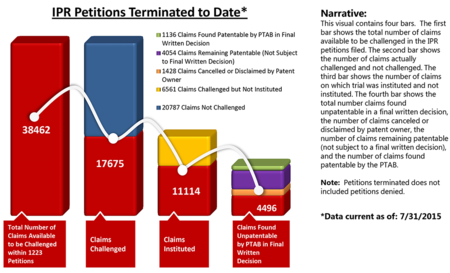
    Director Lee notes on her blog that only a small percentage (12%) of claims found "challengeable" by the PTAB have been invalidated (4496/38642), but does not describe "[o]ther claims [that] were either not challenged, resolved by settlement, cancelled, or upheld as patentable"; overall, 25% of claims "actually" challenged were held unpatentable in IPRs.

    Not surprisingly, the Director brags a little about how well the Office has done under the procedural constraints contained in the law:

    Although the total number petitions filed to date reflect around three times more than what we initially anticipated, we are especially pleased that the PTAB has nonetheless maintained a perfect record in rendering all its final decisions within the mandated time frame of one year.  (And without using the six-month "good cause" extension for any trial or employing the temporary safety-valve "cap" provided by Congress to decline further petitions.)  We are also pleased that those final PTAB decisions that have been appealed to the U.S. Court of Appeals for the Federal Circuit (CAFC) have been affirmed at a very high rate.

    The blog post also includes a link to slides from which this synopsis was made.

    These slides include the number of petitions (by type and cumulative) filed each month) (click on slides to enlarge):

    Slide_3
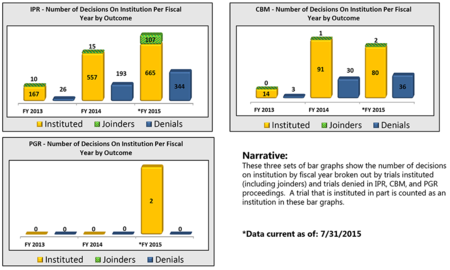
    The decisions on petition for each type per year:

    Slide_7
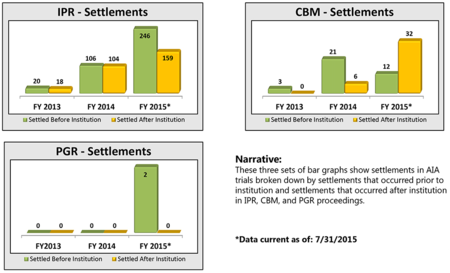
    The number of settlements:

    Slide_8
    And the procedural history of the total IPR petitions completed to date:

    Slide_9
    The latter chart is particularly informative: of 1,777 IPR petitions "completed" by July 31st, 827 trials were instituted (46%).  Only 447 of these went through the trial, and of these 295 trials ended with all claims found unpatentable (66%), 81 with some claims unpatentable (18%), and 71 with no claims found unpatentable (16%).  The disposition of IPRs by claim is as follows:

    Slide_12

    According to the slides, these data (including the date in the Director's synopsis) are current to July 31, 2015.

  • By Michael Borella

    USPTO SealOn July 30, 2015, the U.S. Patent and Trademark Office updated its subject matter eligibility guidance ("Eligibility Update").  This update provides recommendations and resources for examiners in addition to those in the Office's 2014 Interim Guidance on Subject Matter Eligibility.  In particular, the Office addressed several broad themes from comments it received on the Interim Guidance.  The focus of this article is on how the Eligibility Update potentially impacts claims that may incorporate abstract ideas.

    In the Eligibility Update, the Office provides supplementary analyses of hypothetical claims, some patent eligible and some not.  However, unlike the abstract idea examples that the Office published in January of this year, these analyses include sets of claims, for a given invention, that were both eligible and ineligible.  Such examples may prove to be quite valuable, as they allow applicants to focus in on features and claim language that can transform a claim that is too abstract into one that meets the subject matter requirements.

    The new example claims include some directed to distribution of stock quotes, graphical user interfaces, and remote loading of Basic Input / Output System (BIOS) bootstrap code on a computer, along other hypotheticals.  Unsurprisingly, the ineligible claims tend to be pure business method or disembodied processes, while the eligible claims involve a more substantial change in the operation of a computer.

    When discussing these examples, the Office notes that the second prong of the patent-eligibility test from Alice Corp. v. CLS Bank Int'l (for a claim incorporating an abstract idea, determining whether the claim recites "significantly more than a patent upon the ineligible concept itself") requires that examiners consider the additional claim elements both individually and as an ordered combination.  The Office writes that "even if an element does not amount to significantly more on its own . . . it can still amount to significantly more when considered in combination with the other elements of the claim."  Particularly, the Office states that, in some cases, "generic computer components that individually perform merely generic computer functions . . . are able in combination to perform functions that are not generic computer functions and that amount to significantly more."  This is welcome news, as examiners all too often view the elements of claims in isolation when evaluating patent eligibility (as well as other patentability requirements for that matter).

    The Office also provides supplementary material on how examiners should endeavor to identify abstract ideas.  Due to the Supreme Court's decision in Alice to purposely not define abstract ideas other than by example, the Office is now following the strategy employed by some Federal Circuit and district court judges — compare the claims at issue to those found in relevant case law.  This "walks like a duck" test expands the two-prong Alice inquiry into a more complex animal.  The examiner reviews the claims in light of the several dozen Supreme Court and Federal Circuit decisions finding claims ineligible under 35 U.S.C. § 101 (e.g., Alice, Bilski v. Kappos, Ultramercial, Inc. v. Hulu, LLC, etc.), as well as the two decisions finding challenged claims eligible (Diamond v. Diehr and DDR Holdings, LLC v. Hotels.com, L.P.).  While there are several other examples of claims that pass muster under § 101 in this Eligibility Update, Diehr and DDR Holdings are the only two cases addressing eligible claims involving abstract ideas that have either been blessed by the Supreme Court or decided post-Alice by the Federal Circuit.  Once the examiner has conducted the comparison, an eligibility decision is made based on the likeness (or lack thereof) of the examined claims to the relevant case law.

    This process could be faulted as being more than a little inexact.  Ultimately, however, the finger must be pointed back to the Supreme Court.  The Office is merely following the example of the Federal Circuit, the panels thereof struggling to interpret Alice and its predecessors.

    But the Eligibility Update does provide some clarity with respect to the intersection of § 101 with §§ 102 and 103.  The Office writes "[w]hen identifying abstract ideas, examiners should keep in mind that judicial exceptions need not be old or long‐prevalent, and that even newly discovered judicial exceptions are still exceptions, despite their novelty."  Pointing to Parker v. Flook, Mayo Collaborative Svcs. v. Prometheus Labs, and Ultramercial as examples, the Office contends that the claims of these cases tied up "basic tools of scientific and technological work that lie beyond the domain of patent protection."  Thus, an argument rebutting a § 101 rejection or invalidity contention by pointing out the novelty of the claimed invention is likely dead on arrival.

    The Office then goes on to discuss four particular categories of claims that are likely to be viewed as abstract.  The Office made it clear that these categories are not mutually exclusive, and that claims can belong to two or more.

    • Fundamental economic practices, in the Office's view, are "concepts relating to the economy and commerce, such as agreements between people in the form of contracts, legal obligations, and business relations."  But, "[t]he term 'fundamental' is used in the sense of being foundational or basic, and not in the sense of necessarily being 'old' or 'well‐known.'"  The Supreme Court, however, made a distinction between claims directed to "fundamental economic practices" and "fundamental truths" in Alice.  The former is "long prevalent in our system of commerce" (i.e., in the prior art), while the latter "an original cause; a motive" that "exist[s] in principle apart from any human action."  The Court differentiated between these two, noting that the claims of Bilski involved "a method of organizing human activity, not a truth about the natural world that has always existed."

    • Regarding the organization of human activity, the Office concedes that "not all methods of organizing human activity are abstract ideas."  For instance, human operation of machines does not fall into this category.  Instead, these methods may include "concepts relating to interpersonal and intrapersonal activities, such as managing relationships or transactions between people, social activities, and human behavior; satisfying or avoiding a legal obligation; advertising, marketing, and sales activities or behaviors; and managing human mental activity."

    • An idea of itself, according to the Office, is "an idea standing alone such as an uninstantiated concept, plan or scheme, as well as a mental process (thinking) that can be performed in the human mind, or by a human using a pen and paper."  Examples of such ideas include comparisons of data, performing tests and thinking about the results, using categories to process information, and the display of advertising in exchange for access to media of Ultramercial.

    • Mathematical relationships and formulas, as another example, are "used to describe mathematical concepts such as mathematical algorithms, mathematical relationships, mathematical formulas, and calculations."  Instances of claims addressing such relationships or formulas can be found in the Supreme Court cases of Benson v. Gottschalk, Flook, Diehr, and Bilski.

    The Office adds some further clarity when it discusses the requirements of a prima facie case of patent ineligibility.  Many § 101 rejections coming out of the Office are conclusory in nature, leaving the applicant with little substance to rebut.  This has led commenters to request that the Office clarify the examiner's burden in this regard.

    The Office begins by stating that "performing a thorough analysis and writing a clear rejection is a critical part of satisfying the examiner's burden."  Moreover, "the examiner's burden is met by clearly articulating the reason(s) why the claimed invention is not eligible, for example by providing a reasoned rationale that identifies the judicial exception recited in the claim and why it is considered an exception, and that identifies the additional elements in the claim (if any) and explains why they do not amount to significantly more than the exception."  In doing so, the examiner "may rely, where appropriate, on the knowledge generally available to those in the art, on the case law precedent, on applicant's own disclosure, or on evidence."

    Addressing whether subject matter eligibility decisions require factual findings, the Office appears to answer this question in the negative.  Particularly, "determination of whether a claim is eligible [is] a question of law" and "courts do not rely on evidence that a claimed concept is a judicial exception, and in most cases resolve the ultimate legal conclusion on eligibility without making any factual findings."  Instead, the Office instructs examiners to "rely on what the courts have recognized, or those in the art would recognize, as elements that are well‐understood, routine and conventional" — in other words, to apply the "walks like a duck" test.

    Notably, with reference to the second prong of the Alice framework, the Office indicates that evidence is not necessarily "required to support a finding that the additional elements were well‐understood, routine or conventional, but [examiners should] treat the issue as a matter appropriate for judicial notice."  Thus, "a rejection should only be made if an examiner relying on his or her expertise in the art can readily conclude [by applying second prong of the Alice] that the additional elements do not amount to significantly more."

    One of the more mysterious aspects of § 101 post-Alice is the role of preemption in the analysis.  The Supreme Court stated in that case that the "preemption concern . . . undergirds our §101 jurisprudence."  The Office, however, believes that "questions of preemption are inherent in the two‐part framework from Alice Corp. and Mayo . . . , and are resolved by using this framework to distinguish between preemptive claims" and those that are not.  But, as set forth in Ultramercial, "absence of complete preemption does not guarantee that a claim is eligible."  Here, the Office does not resolve the preemption issue, but instead chooses not to address it directly at this point.

    Finally, the Office tackles concerns of when its streamlined § 101 analysis may be used.  The Interim Guidance allows examiners to skip the Alice test for "claims that clearly do not seek to tie up any judicial exception such that others cannot practice it."  The Office reiterates that the outcome of the patent-eligibility analysis will be the same whether the streamlined analysis or the full Alice procedure is used.  Notably, examiners do not need to indicate when the streamlined analysis has been employed, as "the record may reflect the conclusion of eligibility simply by the absence of an eligibility rejection or may include clarifying remarks."

  • By Kevin E. Noonan

    Acorda TherapeuticsOne of the statistics gleaned from Director Michelle Lee's recent blog on the post-issuance review provisions of the America Invents Act is that only 42% of inter partes review petitions have been granted over the past three years.  There is no statistic in the Director's link to a more detailed description of the data regarding the correlation between petitions being denied and the patentee exercising its right to challenge the petition by filing a Preliminary Response (see "Patent Trial and Appeal Board Statistics," July 31, 2015).  But logic suggests that the Board might be less likely to grant a petition if the patentee gave them reasons not to do so.

    This is what happened in two petitions for inter partes review filed by the Coalition for Affordable Drugs (ADROCA) against two patents owned by Acorda Therapeutics.  The Patent Trial and Appeal Board (PTAB) issued a pair of decisions today denying these petitions, using almost identical language and based on parallel reasoning.

    The patents were directed to a multiple sclerosis drug (4-aminopyridine) and methods for treating MS by administering this drug.  In one petition, ADROCA challenged claims 1-8 of U.S. Patent No. 8,663,685; claim 1 is representative:

    1.  A method of improving walking in a human multiple sclerosis patient in need thereof comprising orally administering to said patient a sustained release composition of 10 milligrams of 4-aminopyridine twice daily for a time period of at least two weeks, wherein the sustained release composition further comprises one or more pharmaceutically acceptable excipients.

    In the other, claims 1-3, 5-8 and 10-41 of U.S. Patent No. 8,007,826 were the subject of the ADROCA petition; claim 1 and 6 are representative:

    1.  A method for maintaining a therapeutically effective concentration of 4-aminopyridine in order to improve walking in a human with multiple sclerosis in need thereof, said method comprising: orally administering to the human a sustained release composition of 10 milligrams of 4-aminopyridine twice daily for a day; and thereafter, maintaining administration of 4-aminopyridine by orally administering to said human a sustained release composition of 10 milligrams of 4-aminopyridine twice daily for a time period of at least two weeks, whereby an in vivo 4-aminopyridine CmaxSS:CminSS ratio of 1.0 to 3.5 and a CavSS of 15 ng/ml to 35 ng/ml are obtained in the human.

    6.  A dosing regimen method for providing a 4-aminopyridine at a therapeutically effective concentration in order to improve walking in a human with multiple sclerosis in need thereof, said method comprising: initiating administration of 4-aminopyridine by orally administering to said human a sustained release composition of 10 milligrams of 4-aminopyridine twice daily for a day without a prior period of 4-aminopyridine titration, and then, maintaining administration of 4-aminopyridine by orally administering to said human a sustained release composition of 10 milligrams of 4-aminopyridine twice daily; without a subsequent period of 4-aminopyridine titration, whereby an in vivo 4-aminopyridine CmaxSS:CminSS ratio of 1.0 to 3.5 and a CavSS of 15 ng/ml to 35 ng/ml are maintained in the human.

    In the petition regarding the claims of the '685 patent, petitioner asserted three grounds of invalidity, all sounding in obviousness.  The asserted references were a poster by Goodman, entitled "Placebo-Controlled Double-Blinded Dose Ranging Study of Fampridine-SR in Multiple Sclerosis" which was used alone or in combination with a poster by Hayes entitled "Open-Label, Multiple-Dose Study to Determine the Pharmacokinetics and Safety of Fampridine-SR (Sustained-Release 4- Aminopyridine) in Patients with Chronic Spinal Cord Injury."  These same references were asserted against the claims of the '826 patent, in support of two grounds of asserted obviousness in view of either the Goodman or the Hayes posters.

    The Board denied the petitions to initiate based on their determination that petitioner had not established that either poster was prior art.  As an initial matter, the Board stated that the presence of both poster references on Information Disclosure Statements (IDSs) filed by the inventors was not an admission that the references were prior art, citing citing 37 C.F.R. § 1.97(h) and Abbott Labs. v. Baxter Pharm. Prods., Inc., 334 F.3d 1274, 1279 (Fed. Cir. 2003).  The Board then set out the relevant considerations for whether a poster was a "printed publication" under 35 U.S.C. §102(b), citing In re Klopfenstein, 380 F.3d 1345, 1349 n.4 (Fed. Cir. 2004).  The evidence established that the poster was "a temporarily displayed reference that was neither distributed nor indexed" and under these circumstances the standard under Klopfenstein for showing a reference to be §102(b) prior art required consideration of the following:

    [1] the length of time the display was exhibited, [2] the expertise of the target audience, [3] the existence (or lack thereof) of reasonable expectations that the material displayed would not be copied, and [4] the simplicity or ease with which the material displayed could have been copied.

    Here, the Board found that there was insufficient evidence regarding the first prong or second prongs of the test.  The Board also commented that the posters comprised "relatively dense material in a small space," and that the "more complex a display, the more difficult it will be for members of the public to effectively capture its information," citing Klopfenstein.  On this basis the Board found that the petitioner presented insufficient evidence that there could be "any reasonable expectation that one could have copied the poster material, or evidence regarding the ease with which the poster material could have been copied."

    These determinations applied to both the Goodman and the Hayes posters and in the petitions for inter partes review of both the '685 and '826 patents, and accordingly the Board denied the petitions to institute inter partes review against either patent.

    Petitions like the ones filed against the Acorda patent have raised concerns regarding potential abuses to the inter partes review process.  However, outcomes like these, and the statistics contained in the Director's blog, suggest that any such problems may be less compelling than has been feared, particularly as more savvy observers realize that there can be a great difference between filing an inter partes review petition and having a trial instituted by the Board.

  •         By Sherri Oslick

    Gavel About Court Report:  Each week we will report briefly on recently filed biotech and pharma cases.

    Reckitt Benckiser LLC v. Dr. Reddys Laboratories, Inc. et al.
    1:15-cv-04524; filed June 26, 2015 in the District Court of New Jersey

    • Plaintiff:  Reckitt Benckiser LLC
    • Defendants:  Reckitt Benckiser LLC; Dr. Reddys Laboratories, Ltd.

    Infringement of U.S. Patent Nos. 6,372,252 ("Guaifenesin Sustained Release Formulation and Tablets," issued April 16, 2002), 6,955,821 ("Sustained Release Formulations of Guaifenesin and Additional Drug Ingredients," issued October 18, 2005), and 7,838,032 ("Sustained Release of Guaifenesin" issued November 23, 2010) following a Paragraph IV certification as part of Dr. Reddy's filing of an ANDA to manufacture a generic version of plaintiff's Mucinex® D (guaifenesin/pseudoephedrine hydrochloride, respectively, used to treat chest congestion).  View the complaint here.

    Jazz Pharmaceuticals, Inc. v. Watson Laboratories, Inc.
    2:15-cv-04532; filed June 26, 2015 in the District Court of New Jersey

    Infringement of U.S. Patent Nos. 8,859,619 ("Microbiologically Sound and Stable Solutions of Gamma-Hydroxybutyrate Salt for the Treatment of Narcolepsy," issued October 14, 2014) and 8,952,062 (same title, issued February 10, 2015) following a Paragraph IV certification as part of Watson's filing of an ANDA to manufacture a generic version of Jazz's Xyrem® (sodium oxybate, used to treat narcolepsy).  View the complaint here.

    Immunomedics, Inc. v. Board of Directors of Roger Williams Medical Center et al.
    2:15-cv-04526; filed June 26, 2015 in the District Court of New Jersey

    • Plaintiff:  Immunomedics, Inc.
    • Defendants:  Board of Directors of Roger Williams Medical Center; M.D., PH.D. Richard P. Junghans; M.D. Steven C Katz; Office of the Board of Advisors of Tufts University School of Medicine; ABC Entities 1-10; John Does 1-10

    Infringement of U.S. Patent Nos. 5,874,540 ("CDR-grafted Type III Anti-CEA Humanized Mouse Monoclonal Antibodies," issued February 23, 1999), 6,676,924 (same title, issued January 13, 2004), and 6,926,893 ("Multi-stage Cascade Boosting Vaccine," issued August 9, 2005) based on defendants' use, development and distribution of, and publication of information about antibodies or uses of antibodies allegedly covered by the '540 patent, and numerous claims sounding in tort.  View the complaint here.

  • Standard Essential Patents Unenforceable on Theory of Indirect Infringement

    By Joseph Herndon

    JVC KenwoodA recent decision by the Federal Circuit in JVC Kenwood Corp. v. Nero, Inc., decided August 17, 2015, involves nuanced details of standard-essential patents, but arrived at a common sense result:  either the patents at issue are standard-essential and thus licensed by defendant, or plaintiff cannot solely rely on the licensed technology standards to show infringement.

    Here, JVC Kenwood Corporation ("JVC") sued Nero, Inc. and Arcsoft, Inc. for contributory and induced infringement ("indirect infringement") of certain JVC patents directed to various uses of DVD and Blu-ray optical discs.  The charge of indirect infringement is based on Nero's sale of software to end users of DVD and Blu-ray discs, who allegedly directly infringe the JVC patents.

    Patents at Issue and Infringement Allegations

    There are six JVC Patents are at issue, directed to aspects of optical discs and specific structures, methods, or systems used with optical discs such as "jump reproduction" — e.g., fast-forwarding, fast-rewinding, etc., methods of recording moving picture data on a recording medium (i.e., burning data to DVDs and Blu-Ray discs), and methods of controlling whether certain kinds of content, such as a "R" rated movie on a DVD, should be played according to preconditions (i.e., implementation of parental controls) (see, e.g., U.S. Patent No. 6,522,692).

    The record describes two licensing pools for optical disc technology including the DVD Patent Licensing Group (also called DVD6C), and One Blue LLC for Blu-ray technology.  JVC is a member of both groups, and the Patents in suit are included in both pools, and thus, are considered standard-essential patents for this technology.

    For the DVD6C pool, the DVD6C license for DVD Patents "extends only to the structure, features and functions of a DVD Product used to practice those DVD Standard Specifications or +R/+RW Standard Specifications applicable to that DVD Product and for which the DVD Patents are Essential."  The DVD Standard Specifications are a series of documents setting forth the technical qualifications for standards-compliant products.  They are published by the DVD Forum, an international association tasked with defining the DVD Specifications.

    The One Blue patent licensing arrangement is similar.  One-Blue licenses can be obtained for specific categories of Blu-ray products, and "applies only to the extent the structure, features and functions of a BD Registered Product are used to practice" the applicable standards.

    Some of JVC's infringement contentions include that when end-users use Nero software with blank optical discs to record moving picture data, they directly infringe by practicing a specified "method of recording moving picture data on a recording medium," of one of the JVC patents.  JVC also alleged that "when the end-user then uses Nero software to reproduce (playback) the moving picture data and to fast forward (or fast reverse) through the content, the end-user directly infringes" claims of the JVC patents.  Still further, JVC alleged that when an end-user uses Nero software to perform the parental/regional control functions as recited in the claims, the end-user directly infringes claims of the JVC patents.

    For all six standard-essential JVC Patents, JVC alleged that since Nero's software customers are direct infringers, Nero is liable for induced or contributory infringement as provider of the software.

    JVC attempted to prove indirect infringement by showing that Nero is a licensed member of the DVD Format/Logo Licensing Corporation ("DVD FLLC"), the licensing agent for the DVD Forum, which is responsible for licensing the Format Books setting forth the DVD standards specifications and the DVD logo.  JVC stated that Nero is bound by the terms of the DVD FLLC license agreement, which requires all products manufactured or sold by the licensee to comply with the standards set forth in the Format Books.  JVC's theory of infringement is based on a standards-compliance theory of infringement, in that, since Nero's software necessarily complies with the standards specifications, use of Nero's software by end users for the purposes described in any of the Patents (which are standards-compliant), directly infringes the relevant Patent.

    District Court Result

    The District Court held that direct infringement of the patented systems, methods, and apparatuses, as alleged by JVC, is negated by the "extensive licensing program, both as part of the DVD6C and One Blue patent pools as well as through JVC's individual licensing program."  The District Court generally observed that licensees cannot be infringers.

    The District Court held that JVC is "barred from asserting claims of direct infringement against end users for use of Nero software with DVD and Blu-ray optical discs made or sold by a party whose products have been expressly released from claims of infringement by JVC with regard to the Patents."  The District Court also held that, absent direct infringement, Nero cannot be liable for indirect infringement.

    The District Court found that because Nero has shown an extensive licensing program, both as part of the DVD6C and One Blue patent pools as well as through JVC's individual licensing program, there cannot be infringement without specific allegations and evidence showing use of unlicensed optical discs.

    Federal Circuit Result

    JVC appealed and argued that licensees to the DVD6C pool only receive a license to those patents related to particular products, selected by the licensee, which "practice the DVD Standard Specifications" applicable to the licensee's products, citing the DVD6C License Agreement.  Thus, JVC tried to argue that Nero's license, as a member of DVD FLLC, varied from the standards-essential patent license.

    The Federal Circuit shot down JVC's arguments, and noted that, based on the proffered evidence of infringement, summary judgment of non-infringement was properly granted.  JVC cited no "specific allegations and evidence" of any unlicensed discs.

    The Federal Circuit thus affirmed the District Court's ruling, and further stated that on JVC's premise that these Patents are essential and are directly infringed by users of Nero software, it was JVC's burden to proffer at least plausible evidence in support of its position that unlicensed optical discs were in use.  JVC offered no evidence of specific unlicensed discs.

    The Federal Circuit noted that JVC cannot have it both ways — either the Patent is essential and licensed or JVC cannot solely rely on compliance with the standards to show infringement as it has chosen to do.

    While JVC may have slipped up by overlooking evidentiary procedures, or possibly was unable to prove that any unlicensed discs exist, the result here seems to come out as common sense (i.e., licensed patents cannot be infringed).  This decision is further important to provide support for the notion that such licensed patents also cannot be indirectly infringed.  While the result is not so broad, it does help support companies who have obtained licenses from later attacks of indirect infringement via use by end users.  Downstream assertion of standard-essential patents, or two bites at the apple for patent holders (a first against companies as licensees and a second against the companies as indirect infringers) is not likely to be allowed by the Federal Circuit.

    Patent Exhaustion

    An alternative holding was advanced by the District Court, however, regarding patent exhaustion.  The District Court applied Quanta and stated that "here, [JVC] has suggested no reasonable use for the [licensed DVD and Blu-ray optical discs] other than . . . practice[ing] the [JVC] Patents."

    The Federal Circuit declined to opine directly on this issue for a few reasons.  Notably, the Federal Circuit found that the District Court clearly and effectively determined that infringement had not been shown on JVC's theory and argument of the case, and thus, any further holding of patent exhaustion would have been redundant for purposes of assertion of the patents.  In addition, the Federal Circuit found that the "sketchy record, contradictory arguments, and undeveloped facts before us" did not enable them to expand the theory of patent exhaustion to reach this case.  Thus, with facts material to the issue of patent exhaustion being insufficiently developed to warrant summary judgment on that alternative ground, the District Court's ruling with respect to patent exhaustion was vacated.

    It was further noted that in arguing that the District Court improperly applied the criteria of patent exhaustion, JVC also negated its own theory of infringement (e.g., if the Patents represent a "substantial embodiment" of the optical discs as sold — as JVC argued in support of infringement — then the Patents are exhausted on sale of the discs).  This contradiction, and lack of details in evidence led the Federal Circuit to punt on the issue of patent exhaustion.

    JVC Kenwood Corp. v. Nero, Inc. (Fed. Cir. 2015)
    Panel: Circuit Judges newman, Dyk, and Reyna
    Opinion by Circuit Judge Newman

  • CalendarAugust 24, 2015 – Roadshow on Patent Quality and AIA Trials (American Intellectual Property Law Association and U.S. Patent and Trademark Office) – Santa Clara, CA

    August 26, 2015 – Roadshow on Patent Quality and AIA Trials (American Intellectual Property Law Association and U.S. Patent and Trademark Office) – Dallas, TX

    August 27, 2015 – "Meet the New Boss. Same as the Old Boss? Not Even Close under New Mayo/Alice Regime for § 101" (McDonnell Boehnen Hulbert & Berghoff LLP) – 10:00 am to 11:15 am (CT)

    August 27, 2015 – "Biosimilars: Regulation, Litigation and New Developments Patent Practitioners and Regulatory Attorneys Should Know" (American Intellectual Property Law Association) – 12:30 – 2:00 pm (Eastern)

    August 27, 2015 – "PTAB Proposed Rule Changes: What's In and What's Out?" (Foley & Lardner) – 12:00 to 1:00 pm (Eastern)

    August 28, 2015 – Roadshow on Patent Quality and AIA Trials (American Intellectual Property Law Association and U.S. Patent and Trademark Office) – Alexandria, VA

    September 1, 2015 – "IP Agreements: Structuring Indemnification and Limitation of Liability Provisions to Allocate Infringement Risk" (Strafford) – 1:00 to 2:30 pm (EDT)

    September 2, 2015 – "Amgen v. Sandoz: What Now?" (Intellectual Property Owners Association) – 2:00 to 3:00 pm (ET)

    September 2, 2015 – "Patent Reform in the US Congress: An Overview of Current Legislation" (American Intellectual Property Law Association) – 12:00 – 1:00 pm (Eastern)

    September 10, 2015 – Biotech Patent Law Road Show (American Intellectual Property Law Association) – Boston, MA

    September 10-11, 2015 - "Advanced Patent Prosecution Seminar 2015: Claim Drafting & Amendment Writing" (Practising Law Institute) – Chicago, IL

    September 15-17, 2015 – World IP Forum (Intellectual Professionals LLP) – Bangkok, Thailand

    September 17, 2015 – "Professional Negligence: Real-Life Case Studies in IP Malpractice & How to Avoid Them" (American Intellectual Property Law Association) – 12:30 – 2:00 pm (Eastern)

    September 18, 2015 – IP & Diagnostics Symposium (Biotechnology Industry Organization) – Alexandria, VA

    September 18, 2015 – Developments in Pharmaceutical and Biotech Patent Law 2015 (Practising Law Institute) – San Francisco, CA

    September 22, 2015 – "The Evolving World of Biosimilars Litigation" (McDonnell Boehnen Hulbert & Berghoff LLP) – 10:00 am to 11:15 am (CT)

    September 24, 2015 – "Trade Secrets and Cybersecurity: Protecting Intellectual Property, Mitigating Loss and Navigating Legal Responses" (Strafford) – 1:00 to 2:30 pm (EDT)

    September 24-25, 2015 - Advanced Patent Law Seminar (Chisum Patent Academy) – Washington, DC

    September 24-25, 2015 – Seminar on European Patent Law (Grünecker) – Munich, Germany

    September 27-29, 2015 – 43rd Annual Meeting (Intellectual Property Owners Association) – Chicago, IL

    October 2, 2015 – Developments in Pharmaceutical and Biotech Patent Law 2015 (Practising Law Institute) – New York, NY

    ***Patent Docs is a media partner of this conference or CLE

  • Biotechnology Industry Organization (BIO)The Biotechnology Industry Organization (BIO) will be holding its third annual IP & Diagnostics Symposium from 8:15 am to 2:30 pm on September 18, 2015 at the Hilton Alexandria Old Town Hotel in Alexandria, VA.  The Symposium will review the current patent law landscape and evaluate the impact on both the genetic diagnostics and biopharmaceutical sectors.  The program will review IP issues for diagnostics and companion diagnostics, and explore new collaborations and regulatory developments.  In hosting the event, BIO aims to inform industry and government alike on how to move the science forward in the current climate.  The Symposium will offer the following presentations and sessions:

    • Session 1 — Strategies for Prevailing on Subject Matter Eligibility Before the PTO and in Litigation — Patent Docs author Donald Zuhn of McDonnell Boehnen Hulbert & Berghoff LLP will moderate a panel consisting of Gloria Fuentes, Legal Director, Patents, Merck; Eric Citron of Goldstein & Russell, P.C.; and Patent Docs author Kevin Noonan of McDonnell Boehnen Hulbert & Berghoff LLP (session sponsored by McDonnell Boehnen Hulbert & Berghoff LLP).

    • Session 2 — The Next Phase – How USPTO and PTAB are Identifying Patent Eligible Subject Matter — Jennifer L. Fox of Brinks Hofer Gilson & Lione will moderate a panel to be announced.

    • Session 3 — Diagnostic Tests-What’s Left to Patent? — Warren Woessner of Schwegman, Lundberg & Woessner, P.A. will moderate a panel consisting of Benjamin Jackson, Vice President Legal Affairs, Myriad Genetics; and Leslie Fischer, Senior Patent Attorney, Novartis Pharmaceuticals Corp.

    • Session 4 (Working Luncheon) — Potential Impacts of Regulatory Changes — Krista Carver of Covington & Burling LLP will moderate a panel consisting of Ellen Flannery of Covington & Burling LLP; E. David Litwack, Policy Advisor, Office of In Vitro Diagnostics and Radiological Health, Center for Devices and Radiological Health; and Allen Nunnally, Associate General Counsel, IP & Corporate, Foundation Medicine, Inc.

    An agenda for the Symposium, including a list of speakers, moderators, and panelists can be obtained here.  Registration information can be found here.