Aris Grigoriou of Study Medicine Europe Ltd. has created an infographic that describes several important drug discoveries.


Patent Law Weblog
Aris Grigoriou of Study Medicine Europe Ltd. has created an infographic that describes several important drug discoveries.
By Sherri Oslick —
 About Court Report: Each week we will report briefly on recently filed biotech and pharma cases.
Horizon Pharma Ireland Ltd. et al. v. Lupin Ltd. et al.
1:15-cv-03051; filed April 30, 2015 in the District Court of New Jersey
• Plaintiffs: Horizon Pharma Ireland Ltd.; HZNP Limited; Horizon Pharma USA, Inc.
• Defendants: Lupin Ltd.; Lupin Pharmaceuticals Inc.
Infringement of U.S. Patent Nos. 8,217,078 ("Treatment of Pain with Topical Diclofenac," issued July 10, 2012), 8,252,838 ("Diclofenac Topical Formulation," issued August 28, 2012), 8,546,450 ("Treatment of Pain with Topical Diclofenac," issued October 1, 2013), 8,563,613 ("Diclofenac Topical Formulation," issued October 22, 2013), 8,618,164 ("Treatment of Pain with Topical Diclofenac," issued December 31, 2013), and 8,871,809 ("Diclofenac Topical Formulation," issued October 28, 2014) following a Paragraph IV certification as part of Lupin's filing of an ANDA to manufacture a generic version of Horizon's Pennsaid® (diclofenac sodium topical solution, used for the treatment of signs and symptoms of osteoarthritis of the knee(s)). View the complaint here.
Apotex Inc v. Daiichi Sankyo, Inc. et al.
1:15-cv-03695; filed April 27, 2015 in the Northern District of Illinois
• Plaintiff: Apotex Inc
• Defendants: Daiichi Sankyo, Inc.; Daiichi Sankyo Co., Ltd.
Declaratory judgment of non-infringement of U.S. Patent No. 6,878,703 ("Pharmaceutical Composition," issued April 12, 2005) in conjunction with Aptoex's filing of an ANDA to manufacture a generic version of Daiichi's Benicar® HCT (olmesartan medoxomil/ hydrochlorothiazide, used to treat hypertension). View the complaint here.
Eli Lilly and Co. et al. v. Lupin Ltd. et al.
1:15-cv-00673; filed April 27, 2015 in the Southern District of Indiana
• Plaintiffs: Eli Lilly and Co.; Daiichi Sankyo Co., Ltd.; Daiichi Sankyo, Inc.; Ube Industries, Ltd.
• Defendants: Lupin Ltd.; Lupin Pharmaceuticals, Inc.
Infringement of certain of U.S. Patent Nos. 8,404,703 ("Medicinal Compositions Containing Aspirin," issued March 26, 2013) and 8,569,325 ("Method of Treatment with Coadministration of Aspirin and Prasugrel," issued October 29, 2013) following a Paragraph IV certification as part of Lupin's filing of an ANDA to manufacture a generic version of Lilly's Effient® (prasugrel hydrochloride, to be used in combination with aspirin for the reduction of thrombotic cardiovascular events in certain patients with acute coronary syndrome (ACS) who are to be managed with percutaneous coronary intervention). View the complaint here.
Noven Pharmaceuticals, Inc. et al. v. Mylan Technologies, Inc. et al.
1:15-cv-00069; filed April 24, 2015 in the Northern District of West Virginia
• Plaintiffs: Noven Pharmaceuticals, Inc.; Hisamitsu Pharmaceutical Co., Inc.
• Defendants: Mylan Technologies, Inc.; Mylan Pharmaceuticals, Inc.; Mylan Inc.
Noven Pharmaceuticals Inc. et al. v. Mylan Technologies Inc. et al.
1:15-cv-00328; filed April 23, 2015 in the District Court of Delaware
• Plaintiffs: Noven Pharmaceuticals Inc.; Hisamitsu Pharmaceutical Co. Inc.
• Defendants: Mylan Technologies Inc.; Mylan Pharmaceuticals Inc.; Mylan Inc.
The complaints in these cases are substantially identical. Infringement of U.S. Patent Nos. 6,841,716 ("Patch," issued January 11, 2005) and 8,231,906 ("Transdermal Estrogen Device and Delivery," issued July 31, 2012) following a Paragraph IV certification as part of Mylan's filing of an ANDA to manufacture a generic version of Noven's Minivelle® (estradiol transdermal system, used for the treatment of moderate to severe vasomotor symptoms due to menopause and for the prevention of postmenopausal osteoporosis). View the Delaware complaint here.
 May 5, 2015 – "Conducting a Freedom to Operate Investigation" (American Intellectual Property Law Association) – 12:30 – 2:00 pm (Eastern)
May 12, 2015 – "Patent Prosecution: Leveraging Declarations to Strengthen Patents Against Post-Grant Proceedings" (Strafford) – 1:00 to 2:30 pm (EDT)
May 12, 2015 – 31st Annual Joint Patent Practice Seminar (Connecticut, New Jersey, New York, and Philadelphia Intellectual Property Law Associations) – New York, NY
May 12-14, 2015 – Fundamentals of Patent Prosecution 2015: A Boot Camp for Claim Drafting & Amendment Writing (Practising Law Institute) – Chicago, IL
May 19, 2015 – "Best Practices for Cost-Effective Filing of PCT and EPO Patent Applications" (Technology Transfer Tactics) – 1:00 to 2:00 pm (Eastern)
May 19-21, 2015 – EU Pharmaceutical Law Forum (Informa Life Sciences) – Brussels, Belgium
May 20, 2015 – "Never Been a Better Time (For IP) Than Right Now?" (Intellectual Property Owners Association (IPO) European Practice Committee) – London, UK
May 28, 2015 – "Hedge Fund IPR Challenges to Pharma Patents: Strategies to Strengthen Patents to Withstand Attack" (Strafford) – 1:00 to 2:30 pm (EDT)
June 1-2, 2015 – Biosimilars (American Conference Institute) – New York, NY
June 4, 2015 – "Navigating Section 112(a) Enablement and Written Description — Withstanding 112(a) Rejections and Attacks on Patent Validity and Patentability" (Strafford) – 1:00 to 2:30 pm (EDT)
June 9-10, 2015 – Due Diligence Summit for Life Sciences (ExL Events) – Boston, MA
June 15-17, 2015 – Fundamentals of Patent Prosecution 2015: A Boot Camp for Claim Drafting & Amendment Writing (Practising Law Institute) – New York, NY
July 8-10, 2015 – Fundamentals of Patent Prosecution 2015: A Boot Camp for Claim Drafting & Amendment Writing (Practising Law Institute) – San Francisco, CA
***Patent Docs is a media partner of this conference or CLE
 The American Intellectual Property Law Association (AIPLA) will be offering a webinar on "Conducting a Freedom to Operate Investigation" on May 5, 2015 from 12:30 – 2:00 pm (Eastern). Les Bookoff of Bookoff McAndrews, Susie Jones of Jones Robb, PLLC, and Bill Shaw of Biogen Idec will explore the role of freedom to operate investigations to startups and large corporations alike, and take the audience through a "mock FTO investigation" that shows the roles of in-house counsel and outside counsel in the FTO process. The panel will also provide practice tips, including crafting an FTO strategy to different budgets, preparing a search letter, and drafting opinions.
The registration fee for the program is $145 (AIPLA member rate) or $175 (non-member rate). Those interested in registering for the program, can do so here.
 Practising Law Institute (PLI) will be holding its Fundamentals of Patent Prosecution 2015: A Boot Camp for Claim Drafting & Amendment Writing seminar on May 12-14, 2015 in Chicago, IL, on June 15-17, 2015 in New York, NY, and on July 8-10, 2015 in San Francisco, CA. The three-day program, which is directed to patent prosecuting and litigating attorneys and patent agents with or without a Patent Office registration number or little patent experience, will focus on teaching the basics of claim drafting, patent application preparation and prosecution, as well as a review of recent developments in the law. A litigator's perspective is also presented to show how drafting and prosecution can influence the development, and often the outcome, of subsequent patent litigation. The seminar will feature lectures in the morning followed by small clinic sessions in the afternoon, with day 1 focusing on invention disclosures and patent preparation, day 2 on prosecution and issuance, and day 3 on litigation and opinion drafting. Lectures will explain:
• How to decide which elements of the invention should be included in the patent application and which aspects should be featured in the claims;
• How to prosecute an application to obtain allowance of an enforceable patent;
• How to interview an Examiner;
• How to use reissues, reexamination supplemental examinations, Inter Partes review and other post-issuance proceedings;
• How to anticipate patent litigation issues during the patent prosecution process; and
• How to approach patent opinion drafting.
PLI faculty will offer presentations on the following topics:
• Taking Invention Disclosures;
• Overview of Claim Drafting and Preparation of Patent Application;
• Claim Drafting;
• Review of Model Claims;
• Patent Prosecution;
• Conducting the Examiner Interview;
• Review of Model Amendment; and
• Litigation Issues.
A program schedule and list of speakers for each of the locations can be found here. Patent Docs authors Kevin Noonan (Chicago co-chair) and Donald Zuhn will be presenting on day 1 at the Chicago seminar.
The registration fee for the conference is $1,895. Those interested in registering for the conference can do so at the PLI website.
 Strafford will be offering a webinar/teleconference entitled "Navigating Section 112(a) Enablement and Written Description — Withstanding 112(a) Rejections and Attacks on Patent Validity and Patentability" on June 4, 2015 from 1:00 to 2:30 pm (EDT). Rekha Bansal, Sr. Director of IP, Principia Biopharma; and Thomas L. Irving, Dr. Jill K. MacAlpine, Deborah M. Herzfeld, and Cory C. Bell of Finnegan Henderson Farabow Garrett & Dunner will provide guidance to patent counsel on leveraging Federal Circuit and PTAB decisions and offer strategies to overcome § 112 challenges or, in the context of AIA's post grant proceedings how to utilize the extant § 112 precedent to break chains of date benefit or mount substantive § 112 attacks in PGR. The webinar will review the following questions:
• What judicial lessons can patent counsel draw when drafting claims and making during ex parte prosecution arguments at the USPTO of written description support and enablement for those claims?
• What steps can counsel for patentees take to meet the written description requirement and withstand invalidity/unpatentability challenges based on written description and enablement, whether at the PTAB, in expert prosecution or in district court litigation?
• What steps can counsel for alleged infringers and/or clients concerned about freedom to operate take to utilize § 112 to make challenges to date benefit/priority in IPRS and to do the same, as well as make substantive § 112 challenges in PRGs?
The registration fee for the webinar is $297 ($362 for registration and CLE processing). Those registering by May 8, 2015 will receive a $50 discount. Those interested in registering for the webinar, can do so here.
 American Conference Institute (ACI) will be holding a conference on Biosimilars on June 1-2, 2015 in New York, NY. ACI faculty will help attendees:
• FDA's approval of Sandoz's Zarxio biosimilar: Analysis of FDA standards for labeling, biosimilarity, interchangeability, and clinical studies;
• Reviewing the biosimilars litigation cases to date including Sandoz v. Amgen and Celltrion v. Janssen and detailing strategies for declaratory judgment actions, preliminary injunctions, and using new USPTO inter partes review procedures;
• US Federal Trade Commission and state law updates: Understanding the controversy surrounding competition, substitution, and naming in the biosimilars arena; and
• Cost-benefit analysis: determining the potential value of biosimilars revenue based on relevant pricing, IP, regulatory, and commercial factor.
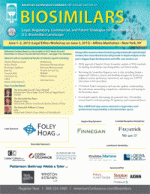 In particular, ACI's faculty will offer presentations on the following topics:
• FDA Keynote Address: Insights into FDA's Current Position and Initiatives Regarding Biosimilars
• The Road Ahead: Minimizing the Uncertainty Surrounding FDA Standards for Interchangeability and Biosimilarity
• Protecting Both Innovation and Competition: Finding Compromise Within Federal and State Biosimilars Substitution Laws
• Biosimilars Around the World: Leveraging Regulatory, IP, Pricing, and Safety Lessons Learned So Far
• Judges’ Spotlight: Lessons from the Hatch-Waxman Experience for Biosimilars Litigation
• Declining to Dance? Lessons Learned from Early BPCIA Cases on Whether the Pathway is Mandatory
• What’s at Stake: Commercial Opportunity, Risk, and Pricing Considerations for the Emerging U.S. Biosimilars Landscape
• Incorporating Inter Partes Review and New USPTO Procedures Into Branded and Biosimilar Litigation Strategies
• Following the Rules of the BPCIA: A Cheat Sheet for Managing the Complicated Timing and Logistics of the Statutory IP Exchange Process
• The Next Battle Ground: Strategies for Obtaining or Challenging Preliminary Injunctions
• Obtaining Adequate Patent Protection While Operating in an "Anti-Patent" Climate: Factoring Key Cases into Your Biosimilars Patent Strategy
• Open Floor Session Benchmarking Session: Putting It All Together: Is the Biosimilars Abbreviated Pathway Worth It?
In addition, a post-conference workshop, entitled "Workshop: Legal Ethics and Professional Responsibility: Avoiding Conflicts of Interest, Maintaining Confidentiality, and Other Special Concerns for the Biosimilars Space," will be offered from 9:00 am to 12:00 pm on June 3, 2015. The post-conference workshop will be presented in part by Patent Docs author Dr. Kevin Noonan.
The agenda for the Biosimilars conference can be found here and an agenda for the post-conference workshop can be found here. A complete brochure for this conference, including an agenda, detailed descriptions of conference sessions, list of speakers, and registration form can be obtained here.
 The registration fee for the conference is $2,195 (conference alone) or $2,695 (conference and post-conference workshop). Those interested in registering for the conference can do so here, by e-mailing CustomerService@AmericanConference.com, by calling 1-888-224-2480, or by faxing a registration form to 1-877-927-1563.
Patent Docs is a media partner of the Biosimilars conference.
 Strafford will be offering a webinar/teleconference entitled "Hedge Fund IPR Challenges to Pharma Patents: Strategies to Strengthen Patents to Withstand Attack" on May 28, 2015 from 1:00 to 2:30 pm (EDT). Rekha Bansal, Sr. Director of IP, Principia Biopharma; and Thomas L. Irving, Dr. Amanda K. Murphy, and Dr. Barbara R. Rudolph of Finnegan Henderson Farabow Garrett & Dunner will provide patent counsel with guidance on the recent inter partes review (IPR) challenges by hedge funds to pharmaceutical patents, examining the patents that are being attacked and the grounds for attack, and discuss the lessons learned from these challenges and will offer strategies for strengthening patents to withstand attack. The webinar will review the following questions:
• What types of pharma patents are being challenged in representative patents challenged by hedge funds in IPR?
• What grounds are being asserted?
• What can the pharma patent owner do to strengthen their patents to enhance the chance of survival in IPR, irrespective of the identity of the petitioner?
The registration fee for the webinar is $297 ($362 for registration and CLE processing). Those registering by May 8, 2015 will receive a $50 discount. Those interested in registering for the webinar, can do so here.
By Kevin E. Noonan —
 On April 30th, Ambassador Michael B.G. Froman, U.S. Trade Representative (USTR) issued the 2015 Special 301 Report. According to the USTR website, "[m]ade-in-America exports are an essential source of economic growth and well-paying, Middle Class jobs in the United States." Further, "American innovation and creativity are a cornerstone of our economic strength and competitiveness. U.S. companies and workers generate many of the innovative breakthroughs that have saved and enriched lives in the United States and abroad. The content produced by America's creative industries is enjoyed worldwide, and U.S. brands are among the most valued and trusted internationally."
The Report notes that "[s]trong and balanced protection and enforcement of intellectual property are critical for promoting exports of U.S. innovative and creative goods and services, and sustaining those jobs here at home" because "[t]ens of millions of Americans owe their jobs to intellectual property-intensive industries." The Special 301 Report is an "important tool" in these efforts and also is "a demonstration of this Administration's resolve – to ensure that Americans can bring their inventions and creations to people all over the world without their work being infringed or misappropriated."
 The Report highlights China as a country that, although still on the Priority Watch List has made a "wide-ranging intellectual property law reform effort" as well as "certain positive enforcement initiatives" but notes that there are both "new and longstanding concerns about IPR protection and enforcement," especially with regard to trade secret protection and "technology localization." The USTR also cites what he calls "increased bilateral engagement" between the U.S. and India, and while India remains on the Priority Watch List there is "the full expectation that the new channels for engagement created in the past year will bring about substantive and measurable improvements in India's IPR regime for the benefit of a broad range of innovative and creative industries." On a less positive note USTR cautions that there are "serious and ongoing concerns with respect to the environment for IPR protection and enforcement in Turkey, Indonesia, Russia, [and] Argentina" as well as in other markets. The USTR also announced plans to perform "Out-of-Cycle" reviews of Honduras (which warrants scrutiny due to "widespread cable and satellite signal piracy" from that nation), Ecuador, Paraguay, Spain, Tajikistan, and Turkmenistan; the Report specifically called out Tajikstan and Turkmenistan as countries willing to cooperate with the U.S. to improve their IPR regimes and enforcement capabilities. Finally, the Report highlights "progress" in IPR protection in Italy (copyright piracy), the Philippines (increased seizures of pirated and counterfeit goods, among other things), Denmark (which developed a "unit" within their Patent and Trademark Office to help rights holders to enforce patent, design and trademark rights), and both Paraguay and the Philippines for taking a "whole government approach" to IPR protection and enforcement.
The Report is promulgated pursuant to Section 182 of the Trade Act of 1974, as amended by the Omnibus Trade and Competitiveness Act of 1988 and the Uruguay Round Agreements Act (enacted in 1994). The Trade Representative is required under the Act to "identify those countries that deny adequate and effective protection for IPR or deny fair and equitable market access for persons that rely on intellectual property protection." The Trade Representative has implemented these provisions by creating a "Priority Watch List" and "Watch List." Placing a country on the Priority Watch List or Watch List is used to indicate that the country exhibits "particular problems . . . with respect to IPR protection, enforcement, or market access for persons relying on intellectual property." These watch lists are reserved for countries having "the most onerous or egregious acts, policies, or practices and whose acts, policies, or practices have the greatest adverse impact (actual or potential) on the relevant U.S. products."
The USTR reviewed 72 of this country's trading partners and identified thirteen countries on a "Priority Watch List" (up from ten last year)) and another 24 countries on the "Watch List" (down from 26 last year), all relating to deficiencies in intellectual property protection in these countries. The Priority Watch List in the 2014 Report cites Algeria, Argentina, Chile, China, India, Indonesia, Pakistan, Russia, Thailand, and Venezuela, countries that were also on the list last year, as well as newcomers Ukraine and Kuwait. Countries on this list "do not provide an adequate level of IPR protection or enforcement, or market access to persons relying on intellectual property protection." On the Watch List this year are Barbados, Belarus (back on the Report this year), Bolivia, Brazil (back on the Report this year), Bulgaria, Canada, Columbia, Costa Rica, Dominican Republic, Egypt, Greece, Guatemala, Jamaica, Lebanon, Mexico, Paraguay, Peru, Romania, Tajikstan, Trinidad and Tobago, Turkey, Turkmenistan, Uzbekistan, and Vietnam; Ecuador, Finland, and Kuwait have left the list compared to last year. The Report lists a "wide range of concerns, including (a) the deterioration in IPR protection, enforcement, and market access for persons relying on IPR in a number of trading partners; (b) reported inadequacies in trade secret protection in China, India, and elsewhere, as well as an increasing incidence of trade secret misappropriation; (c) troubling "indigenous innovation" policies that may unfairly disadvantage U.S. rights holders in China; (d) the continuing challenges of online copyright piracy in countries such as Brazil, China, India, and Russia and trademark counterfeiting in China and elsewhere; (e) market access barriers, including nontransparent and discriminatory measures, that appear to impede access to products embodying IPR and measures that impede market access for U.S. entities that rely upon IPR protection; and (f) other ongoing, systemic IPR enforcement issues in many trading partners around the world."
The Report notes the USTR's continued efforts to enhance public engagement. In addition to written comments ("from over 55 interested parties, including 21 trading partner governments"), there was a public hearing on February 24, 2015 that heard testimony from "representatives of foreign governments, industry, and non-governmental organizations" (where the comments, video, and transcript of the hearing are available on the USTR website). The Report also accentuates coordination between "all relevant agencies within the [Federal] government, informed by extensive consultation with" stakeholders, foreign governments, the Congress and "other interested parties." The assessment of compliance from the countries listed in the Report were conducted on a "case-by-case" basis that "tak[es] into account diverse factors such as a trading partner's level of development, its international obligations and commitments, the concerns of rights holders and other interested parties, and the trade and investment policies of the United States." The Special 301 Subcommittee received input from stakeholders and close to 100 trading partners, selecting the 13 Priority Watch List and 24 Watch List countries from this group.
The Report contains two Sections (on "Developments in Intellectual Property Rights Protection and Enforcement" and "Country Reports") and several Annexes on particular issues (the statutory bases of the Report, government technical assistance an capacity building efforts and WIPO Internet treaties issues). In Section I, the Report notes some "positive developments" in the past year, including "[h]igh-level planning documents" from the PRC "articulat[ing] a commitment to protect and enforce IPR; "administration enforcement reforms in the Philippines; efforts in Italy by its Communications Regulatory Authority (AGCOM) to combat Internet piracy; new guidelines on IPR in Latvia; and efforts in Denmark to assist "consumers and businesses" whose IPR have been infringed. The Report also cited the WIPO Performances and Phonograms Treaty (94 member states) and the WIPO Copyright Treaty (93 member states), and that Korea, Japan and the U.S. have recently acceded to the Hague Agreement Concerning the International Registration of Industrial Design.
The Report contains once again this year a subsection on "best practices" among U.S. trading partners, including "predictability, transparency, and meaningful engagement between governments and stakeholders" in developing IPR law, regulations and practices (emphasis in the Report). These characteristics are important not because the USTR thinks so, but the Report states that "[s]takeholders report that such transparency and participation allow governments to avoid unintended consequences and facilitate stakeholder compliance with legislative and regulatory changes," citing the contrast between India, where stakeholder concerns were taken into account in forming IPR policy, with Thailand where the Report identifies "missed opportunities" in revising its IPR regime that "fail[ed] to address concerns identified by the United States, other foreign governments, and stakeholders." A second point highlighted in the Report is cooperation among various government agencies having an interest in IPR, which the Report states the U.S. has implemented and it encourages our trading partners to join in those efforts.
As in last year's Report, this Report highlights the development and participation in "innovative mechanisms that enable government and private sector rights holders to donate or license pharmaceutical patents voluntarily and on mutually-agreed terms and conditions." Some of the benefits of such programs cited in the Report are "to facilitate the diffusion of technology in support of public policy goals," citing the U.S. government's inaugural participation in the Medicines Patent Pool under the auspices of the World Health Organization and participation of the U.S., Brazil and South Africa in the WIPO Re:Search Consortium, which the Report characterized as "a voluntary mechanism for making IPR and know-how available on mutually-agreed terms and conditions to the global health research community to find cures or treatments for neglected tropical diseases, malaria, and tuberculosis." These are interesting programs that might help reduce the tension between the developed and developing worlds with regard to access to patented pharmaceuticals as evidenced by the provisions of the Doha Declaration and various governments' behaviors justified by that document.
Several multilateral and "plurilateral" initiatives were also mentioned in the Report. As in the Reports from the last several years, these included the Trans-Pacific Partnership (TPP) Agreement, between the U.S. and Australia, Brunei Darussalam, Canada, Chile, Japan, Malaysia, Mexico, New Zealand, Peru, Singapore, and Vietnam; the Transatlantic Trade and Investment Partnership (T-TIP) between the U.S. and the EU; actions by the World Trade Organization in support of IP rights; the Anti-Counterfeiting Trade Agreement (ACTA) between the U.S. and Australia, Canada, Japan, South Korea, Mexico, Morocco, New Zealand, Singapore; that has been signed by Australia, Canada, Japan, Mexico, Morocco, New Zealand, Singapore, South Korea, and the United States (and was signed by the EU but not ratified by the European Parliament); bilateral and regional initiatives, including the U.S.-China Joint Commission on Commerce and Trade (JCCT) and the U.S.-China Strategic and Economic Dialogue (S&ED) and free trade agreements and Trade and Investment Framework Agreements (TIFAs); endorsement by the Asia-Pacific Economic Cooperation (APEC) Intellectual Property Experts Group (IPEG) of a U.S. proposal to "enhanced improved protection and enforcement of trade secrets"; and the USTR Trade Preference Program Reviews such as the Generalized System of Preferences (GSP) program and "regional programs, including the African Growth and Opportunity Act (AGOA), Caribbean Basin Economic Recovery Act (CBERA), and Caribbean Basin Trade Partnership Act (CBTPA)."
The Report then examines trends in Trademark Counterfeiting and Copyright Piracy, which continue to be a problem having "global scale" comprising counterfeit goods that include "semiconductors and other electronics, chemicals, automotive and aircraft parts, medicines, food and beverages, household consumer products, personal care products, apparel and footwear, toys, and sporting goods." The Report asserts that "consumers, legitimate producers, and governments are harmed by trademark counterfeiting and copyright piracy," accentuating harm to the public "by fraudulent and potentially dangerous counterfeit products, including medicines, auto and airplane parts, and semiconductors." Circumstances in India are used again this year to provide an example of "the extent of economic harm" that can result from trademark counterfeiting. The Report cites a report from the International Chamber of Commerce and the Federation of Indian Chambers of Commerce and Industry "analyzing seven key industry sectors vulnerable to counterfeiting, piracy, and smuggling, e.g., automotive parts, alcohol, computer hardware, mobile phones, packaged foods, personal goods, and tobacco products." This study showed losses in India alone of $11.9 billion and a loss to the Indian government of $4.26 billion. The Report also sets forth the following specific trends:
• Many countries provide penalties that fail to deter criminal enterprises engaged in global copyright piracy and trademark counterfeiting operations. Even when such enterprises are investigated and prosecuted, the penalties imposed on them in many countries are low, and therefore, rather than deter further infringements, such penalties only add to the cost of doing business.
• Online sales of pirated and counterfeit goods have the potential to surpass the volume of sales through traditional channels such as street vendors and other physical markets. Enforcement authorities, unfortunately, face difficulties in responding to this trend. Online advertisements for the sale of illicit physical goods are ubiquitous.
• The continued increase in the use of legitimate express mail, international courier, and postal services to deliver counterfeit and pirated goods in small consignments, makes it more challenging for enforcement officials to interdict these goods.
• The practice of shipping products separately from counterfeit labels and packaging to evade enforcement efforts that target the completed counterfeit item continues.
• Media box-based piracy, whereby storage devices, often with capability to play high definition content, are loaded with large quantities of pirated works or are configured to facilitate the user's access to websites featuring unlicensed content, is growing in popularity, reportedly in China, Hong Kong, Indonesia, Malaysia, Taiwan, Thailand, and Vietnam. In 2014, Hong Kong Customs conducted a raid against a syndicate selling preloaded media boxes, arresting nine people and seizing 41 boxes, but greater action and coordination will be needed in this region.
The Report states that the U.S. "continues to urge trading partners to undertake more effective criminal and border enforcement against the manufacture, import, export, transit, and distribution of pirated and counterfeited goods," inter alia, by the USTR "engag[ing] with its trading partners through bilateral consultations, trade agreements, and international organizations to help ensure that penalties, such as significant monetary fines and meaningful sentences of imprisonment, are available and applied so as to have a deterrent effect on counterfeiting and piracy." Equally importantly, the USTR encourages U.S. trading partners to seize and destroy confiscated counterfeit goods and the implements for their manufacture, because "[p]ermitting counterfeit and pirated goods and enabling materials to reenter the channels of commerce after an enforcement action wastes resources and compromises the global enforcement effort." These actions should be taken by the appropriate government officials in each country without requiring a rights holder to lodge a formal complaint, according to the Report.
Counterfeit pharmaceuticals are expressly called out as having negative consequences for public health and safety. The U.S. has "particular concerns" about counterfeiting in Brazil, China, India, Indonesia, Lebanon, Peru, and Russia, with China and India being cited as the sources of most of the counterfeit pharmaceuticals entering the United States. Also cited are efforts by the USAID to support programs in sub-Saharan Africa (SSA) and Asia to protect their citizens against counterfeit and "substandard" medicines (reminding readers that it is frequently the disadvantaged who are the most at risk and the most harmed by counterfeit pharmaceuticals). (The Report contains a section specifically directed towards trademark counterfeiting in Sub-Saharan Africa.) Counterfeits are not limited to finished drug product but also to API (which are thus harder to recognize), being "unlikely to [be] subject[ed] . . . to regulatory oversight or [be made in compliance] with good manufacturing practices." China is specifically identified as a source of such counterfeit API, which escape detection simply by not being identified as being manufactured for use in pharmaceutical products. These counterfeit drugs are said to enter SSA through ports in Kenya, Nigeria and South Africa and then to spread throughout the continent. "These counterfeit goods can endanger lives, displace legitimate products, and adversely affect opportunities for legitimate economic growth," according to the USTR.
Trademark issues and Internet domain name disputes are also mentioned in the Report, due to the importance of these IPRs in distinguishing the source of products and services. Mexico and Russia, and Panama in one particular instance, are named as countries having a lack of opposition procedures or ways to prevent squatters from expropriating "legitimate brand owners" trademarks. Restricted trademark rights and unauthorized uses under "country code top level domain names (ccTLDs)" in some countries are also recited as negatively affecting IPR in some countries.
Turning to software and digital piracy, the Report notes that governments can be the biggest "bad actors" in unauthorized use of software programs. U.S. efforts under Executive Order 13103, issued in September 1998, are cited and "certain trading partners, such as Algeria, China, Costa Rica, Morocco, Pakistan, Paraguay, Tajikistan, Thailand, Ukraine, and Vietnam" are identified as being problematic in this regard. For piracy based on broadband access, the Report cited Brazil, Canada, China, Russia, Switzerland, and Ukraine as countries having "commercial-scale IPR counterfeiting and piracy," and China, India, Paraguay, and Vietnam for optical disk piracy. China, Latin America, the Caribbean and the Middle East are sources of pirated retransmission of sports programming, while somewhat incongruously Switzerland is cited as being a source of increased U.S. concern over online copyright protection, focused on illicit sites that were formerly located in Eastern Europe that have migrated to Switzerland. The Report also contains a section specifically directed to "copyright-related challenges" in the Caribbean, with uncompensated performances of copyrighted music reported in Antigua and Barbuda, Barbados, Belize, Dominica, Grenada, Guyana, Jamaica, St. Lucia, and St. Vincent and the Grenadines, some by government-controlled radio broadcasters. Cable and satellite piracy is reported in Antigua and Barbuda, Barbados, Belize, Dominica, Grenada, Jamaica, St. Kitts and Nevis, Saint Lucia, and St. Vincent and the Grenadines despite there being "strong statutory licensing regimes" simply by the license fees not being paid.
Once again this year the Report contains a subsection on trade secrets and forced technology transfer. Trade secret theft (the Report eschewing the more genteel "misappropriation" moniker) "appears to be escalating" and affect "a wide variety of industry sectors" that include "information and communication technologies, services, biopharmaceuticals, manufacturing, and environmental technologies." Trade secret theft make it "extremely difficult, if not impossible, to recoup past investments in R&D" and compromise future innovation. This can diminish U.S. competitiveness globally, putting American jobs "at risk." It can also threaten U.S. national security interests. Particularly noted in the Report in this regard is China, with trade secret theft being reported by "various sources," including in a publication entitled Foreign Spies Stealing U.S. Economic Secrets in Cyberspace, by the Office of the National Counterintelligence Executive (ONCIX) which stated that "Chinese actors are the world's most active and persistent perpetrators of economic espionage." Theft was cited as involving "departing employees, failed joint ventures, cyber intrusion and hacking, and misuse of information submitted to government entities for purposes of complying with regulatory obligations," with remedies in China being "difficult to obtain." The Report cited a publication by the U.S. Intellectual Property Enforcement Coordinator on February 20, 2013 of "Administration Strategy on Mitigating the Theft of U.S. Trade Secrets," which "highlights U.S. efforts to combat the theft of trade secrets that could be used by foreign governments or companies to gain an unfair economic advantage by harming U.S. innovation and creativity." These include:
• "Focusing diplomatic efforts to protect trade secrets overseas;
• Promoting voluntary best practices by private industry to protect trade secrets, including information security, physical security, and human resources policies;
• Enhancing domestic law enforcement operations, especially through the activities of the Department of Justice, Federal Bureau of Investigations, Department of Defense, and the National IPR Coordination Center;
• Improving domestic legislation to protect against trade secret theft, [and]
• Conducting public awareness campaigns and stakeholder outreach to encourage all stakeholders to be aware of the dangers of trade secret theft."
The Report also notes that "[t]rade secret theft can be viewed as a form of forced technology transfer that foreign actors may use to undermine U.S. competitive advantage." Certain foreign governments, under the guise of promoting "indigenous innovation" can adopt "trade-distortive policies," the Report citing as examples:
• Requiring the transfer of technology as a condition for allowing access to a market, or for allowing a company to continue to do business in the market;
• Directing state-owned enterprises in innovative sectors to seek non-commercial terms from their foreign business partners, including with respect to the acquisition and licensing of IPR;
• Failing to effectively enforce IPR, including patents, trademarks, trade secrets, and copyrights, thereby allowing firms to gain competitive advantages from their misappropriation or infringement of another's IPR;
• Failing to take meaningful measures to prevent or deter cyber intrusions;
• Requiring use of, or providing preferences to, products or services in which IPR is either developed or owned locally, including with respect to government procurement;
• Manipulating the standards development process to create unfair advantages for domestic firms, including with respect to the terms on which IPR is licensed; [and]
• Requiring unnecessary disclosure of confidential business information for regulatory approval, or failing to protect such information.
China, India, Indonesia and Nigeria are specifically identified as countries having policies that amount to such enforced technology transfer.
Next the Report contains sections on "Challenges affecting the Copyright and the Information and Communications Technology Sectors" and "Market Access and Pharmaceutical and Medical Device Innovation." Algeria, India and Indonesia are noted as being of particular concern regarding the latter category of IPR, as well as Algeria, Austria, Belgium, China, Colombia, Czech Republic, Ecuador, Hungary, Italy, Korea, Lithuania, New Zealand, Portugal, Romania, Spain, Taiwan, and Turkey as countries having "issues" related to "pharmaceutical innovation and market access," with specific examples set forth in the Report for several countries.
Once again the Report contains a subsection on IPR and the environment, the Report stating that "[s]trong IPR protection is vital for development, and is critical to responding to environmental challenges, including climate change." Examples include generally promoting investment in "green" technologies and promoting jobs in the green sector, and that "businesses are reluctant to invest or enter into technology transfer arrangements in countries that lack effective IPR protection and enforcement." Cited as examples of governmental actions and activities that "may have the unintended effect of undermining national and global efforts to address serious environmental challenges" are India's National Manufacturing Policy requiring compulsory licensing and its advocacy to "multilateralize" this approach through the UN Framework Convention on Climate Change which will "discourage rather than promote the investment in, and dissemination of, green technologies, including those technologies that contribute to climate change adaptation and mitigation." The Report also reiterates the U.S. government's commitment to "ensure robust IP protection and enforcement [] as an environmental as well as economic imperative."
As it has for the past few years, the Report contains a subsection on "Intellectual Property and Health Policy," again specifically mentioning the 2001 Doha Declaration on the TRIPS Agreement. The Report states that the Declaration "recognized the gravity of the public health problems afflicting many developing and least-developed countries, especially those resulting from HIV/AIDS, tuberculosis, malaria, and other epidemics," and that the U.S. "respects a trading partner's right to protect public health and, in particular, to promote access to medicines for all, and supports the vital role of the patent system in promoting the development and creation of new and innovative lifesaving medicines." Accordingly, the Report states that the U.S. "respects our trading partners' rights to grant compulsory licenses in a manner consistent with the provisions of the TRIPS Agreement, and encourages its trading partners to consider ways to address their public health challenges while maintaining intellectual property systems that promote investment, research, and innovation." The U.S. "strongly supports" the WTO General Council Decision on the Implementation of Paragraph 6 of the Doha Declaration on the TRIPS Agreement and Public Health.
Section I of the Report closes with a discussion of the WTO and particularly its dispute resolution provisions as ways to address issues raised in this and earlier Reports. This portion of the Report contains a synopsis of U.S. efforts to address issues between its trading partners using these mechanisms.
Section II of the Report is a detailed, country-by-country discussion for each country on the Priority Watch List and the Watch List, relating to the activities (or lack thereof) of each country that results in placement of that country on these lists.
As it has for the past several years (and across otherwise very different Administrations), the U.S. Trade Representative Special 301 Report provides insights into both the concerns of U.S. IP rights holders and the Administration's intentions to work with, cajole, coerce, or threaten other countries to increase protection for IP rights of U.S. IP rights holders. By including subsections on the importance of IPR for the environment, and the negative effects of piracy in the pharmaceutical and other areas, the Report seems less focused on mere threats of enforcement and more on developing a global consensus that protection of IPR is an important component of world economic progress for all.
For additional information regarding this and other related topics, please see:
• "U.S. Trade Representative Issues 2014 Special 301 Report," May 19, 2014
• "U.S. Trade Representative Issues 2013 Special 301 Report," May 30, 2013
• "U.S. Trade Representative Issues 2012 Special 301 Report," May 1, 2012
• "U.S. Trade Representative Releases Special 301 Report on Global IPR," May 4, 2011
• "U.S. Trade Representative Releases Special 301 Report on Global IPR," May 19, 2010
• "New Administration, Same Result: U.S. Trade Representative's Section 301 Report," May 6, 2009
• "Congressmen Criticize U.S. Trade Representative over Special 301 Report," July 1, 2008
• "U.S. Continues Efforts to Protect Patent Rights Abroad," April 29, 2008
By Donald Zuhn —
 Last week, diagnostics services provider Quest Diagnostics and Inserm, the French National Institute of Health and Medical Research institution, announced the launch of BRCA Share, a new datashare initiative that will provide scientists and laboratory organizations with open access to BRCA1 and BRCA2 genetic data. According to the initiative's co-founders, the program is intended to accelerate research on BRCA gene mutations, particularly variants of uncertain significance, in order to improve the ability of clinical diagnostics laboratories to predict which individuals are at risk of developing hereditary breast and ovarian cancers. The initiative also announced that the program's first participant would be Laboratory Corporation of America® Holdings (LabCorp®).
 According to the release on the datasharing initiative, BRCA Share builds on a BRCA gene data collection process developed by Inserm, which was developed over the past decade by sixteen laboratories in France that make up the Unicancer Genetic Group (UGG). By pooling clinical laboratory patient data on BRCA1 and BRCA2, members of BRCA Share will help improve risk-assessment for certain cancers by providing greater insight into gene variants of uncertain significance (VUS). The program will be funded by its members on a sliding scale in order to encourage laboratories of all sizes to participate. Researchers and research entities focusing on BRCA will be permitted to participate at no charge. Under BRCA Share, any commercial lab or academic party participating in the program will receive a sublicense provided that the sublicensee agrees to share BRCA data with the other members.
The datashare initiative launched by Quest Diagnostics and Inserm is not the first such effort to collect BRCA data. In June 2013, Genetic Alliance announced the Free the Data! initiative, which was founded to fill the public information gap caused by the lack of available genetic information for the BRCA1 and BRCA2 genes, and which included the University of California San Francisco (UCSF) and InVitae Corporation among its primary founders (see "Consortium Launches Public Database of BRCA Data").
Additional information regarding the BRCA Share initiative can be found here.
 Patent Docs