
By
Kevin E. Noonan —
 A
A
three judge Federal Circuit panel went a long way towards disentangling its
jurisprudence on the question of obviousness-type double patenting, in
affirming a District Court finding that the doctrine did not apply to the
patent claims at issue in Eli Lilly &
Co. v. Teva. In what seems to
becoming a penchant of this Court (see
"Momenta Pharmaceuticals Inc. v. Amphastar Pharmaceuticals,
Inc.: 'The Rest of the Story'"), the panel distinguished its decision rather
than simply finding the Court's most recent spate of decisions to have gone
astray (see "Cert. Denied in Eli Lilly v. Sun
Pharmaceuticals").
The present case concerns pemetrexed, a folate
metabolism inhibitor synthesized by Professor Ed Taylor at Princeton University
and developed by Eli Lilly & Co., sold as the anticancer drug Alimta®
for treating mesothelioma and small cell lung cancer. Pemetrexed's biological activity, as with
earlier folate inhibitors like methotrexate, is understood to result from its
structural similarity to naturally occurring folic acid, which is needed for
DNA and RNA synthesis:


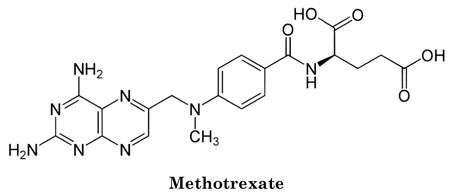
Earlier embodiments of folate inhibitors, like
methotrexate, were disadvantageous because their effects on nucleic acid
metabolism were felt by non-cancerous as well as cancer cells, due to their ability to
inhibit cellular enzymes like dihydrofolate reductase (DHFR) that were needed
for both DNA and RNA production. Pemetrexed was able to specifically inhibit DNA synthesis by virtue of its specificity for enzymes such as thymidylate synthetase (because the nucleotide
thymidine is incorporated into DNA but not RNA).
Princeton University obtained (and Eli Lilly
licensed) three patents related to pemetrexed: U.S. Patent No. 5,344,932 (the patent-in-suit); U.S. Patent No.
5,028,608 and U.S. Patent No. 5,248,775. The '608 patent disclosed and claimed a related but structurally distinct
antifolate compound, and the '775 patent disclosed a "family of chemical
intermediates that can be used to make a variety of antifolates"; important for the
issues on appeal, the '775 patent disclosed an intermediate in antifolate
synthesis that can be used to make pemetrexed (along with a variety of other
antifolate molecules). The '608 and '775 patents expired prior to the instant
suit, while expiration of the '932 patent was delayed until July 14, 2016
pursuant to patent term extension under 35 U.S.C. § 156.
 Eli Lilly sued Teva, Barr Laboratories and APP
Pharmaceuticals after each filed an ANDA, pursuant to 35 U.S.C. § 271(e)(2),
asserting claims 1, 2, 3 and 7 of the '932 patent. At the district court, the defendants
asserted as a defense that the claims of the '932 patent were invalid under the
judicially established doctrine of obviousness-type double patenting over claim
3 of the '608 patent (claiming a related but structurally distinct antifolate
molecule) and claim 7 of the 775 patent (that claims the intermediate). With regard to the '608 patent, Teva
contended at trial that pemetrexed was related to the compound claimed by claim
3 of the '608 patent by substitution of a thienyl group with a phenyl group,
something Teva asserted was "consistent with 'conventional wisdom' in the
field [of the pharmaceutical arts]" and thus rendered the claims invalid. As for the '775 patent, Teva's argument was that the pemetrexed compounds
claimed in the '932 patent were a "use" of the intermediate compound
disclosed in the '775 patent, and were invalid for double patenting under a
line of Federal Circuit cases, the most recent of which was Sun Pharmaceuticals Industries, Ltd. v. Eli
Lilly & Co. In the
alternative, Teva argued that pemetrexed was merely an obvious end product for
the '775 patent intermediate.
The District Court found none of these arguments
persuasive. The Court rejected Teva's "focus"
on the particular portion of pemetrexed that differed from the compound
disclosed in the '608 patent, saying that the weight of the evidence was that
the skilled worker would have "pursued changes outside of the aryl region
to improve TS inhibition and would have avoided introducing a phenyl group into
the '608 Compound based on previous reports of toxicity with analogous
antifolate structures." The basis
for the District Court's rejection of Teva's obviousness-type double patenting
argument over the disclosure of the '775 patent intermediate was that the
intermediate was not claimed ("so the teachings from the '775 patent's
specification were inapplicable to its obviousness-type double patenting
analysis") and that there were many possible end products that could have
been produced from the '775 patent intermediate and no reasoned basis for the
skilled worker to have produced pemetrexed as the end product.
The Federal Circuit agreed, in an opinion by Judge
Lourie joined by Judges Dyk and Wallach. The panel rejected Teva's argument on appeal, that Federal Circuit
precedent (specifically, Amgen Inc. v. Hoffmann-La Roche Ltd., 580 F.3d
1340 (Fed. Cir. 2009)), mandated that a court look only at the differences
between the claims at issue and the earlier claims, "so that any features
held in common between the claims — in this case, all but the aryl regions of the
'608 Compound and pemetrexed — would be excluded from consideration." The panel acknowledged that Amgen directs a court to identify the
differences, but asserts that Amgen
then requires that the claims at issue be considered "as a whole" and
not "the differences [] in isolation." The basis for this analytical framework is
the rubric reasserted in Amgen that
obviousness-type double patenting is assessed "analogous to an obviousness
analysis under 35 U.S.C. §103." And as in a § 103
analysis, claims must be considered "as a whole" in an obviousness-type double patenting analysis says the panel, citing General Foods Corp. v. Studiengesellschaft Kohle mbH, 972 F.2d 1272 (Fed. Cir. 1992). "On the merits," the
panel found no basis for finding clear error in the District Court's factual
determinations underlying its judgment, and "absent any motivation to
derive pemetrexed from the '608 Compound or reason to expect success in doing
so," the panel concluded that the District Court had not erred in finding against
Teva that the asserted claims of the '932 patent were not invalid for
obviousness-type double patenting over the claims of the '608 patent.
Turning to Teva's obviousness-type double patenting
arguments based on the teachings of the '775 patent, the panel noted that these
argument's were rooted in earlier precedent, specifically citing In re Byck,
48 F.2d 665 (CCPA 1931), and Sun Pharmaceutical Industries, Ltd. v. Eli
Lilly & Co., 611 F.3d 1381 (Fed. Cir. 2010). But the panel found this reliance on these
cases "unsound" and proceeded to distinguish this case from that
precedent. The panel began by citing the
"general rule" that obviousness-type double patenting depends on a
comparison with what is claimed in an earlier patent, "with the earlier
patent's written description considered only to the extent necessary to
construe its claims," citing In re Avery, 518 F.2d 1228, 1232 (CCPA
1975). The panel then further reaffirmed
the fundamental principles that the doctrine of obviousness-type double
patenting is concerned with what is claimed, not what is disclosed, because the
goal of the doctrine is to prevent separate patenting of merely obvious
variants of a previously patented invention.
The opinion then characterized the line of cases
relied upon by Teva as "a limited exception" to this rule. The basis for this exception was set forth in
Byck, wherein:
It would shock one's
sense of justice if an inventor could receive a patent upon a composition of
matter, setting out at length in the specification the useful purposes of such
composition, manufacture and sell it to the public, and then prevent the public
from making any beneficial use of such product by securing patents upon each of
the uses to which it may be adapted.
Next, the Court turned to a "trio" of
recent cases: Sun Pharma, Geneva Pharm., Inc.
v. GlaxoSmithKline PLC, 349 F.3d 1373
(Fed. Cir. 2003), and Pfizer, Inc. v. Teva
Pharm. USA, Inc., 518 F.3d 1353 (Fed. Cir.
2008). Each of these cases,
according to the panel, resulted from situations where the second patent
claimed a use of a composition claimed in an earlier patent that disclosed the
later-claimed use. According to the
opinion, these cases each "address the situation in which an earlier
patent claims a compound, disclosing the utility of that compound in the
specification, and a later patent claims a method of using that compound for a
particular use described in the specification of the earlier patent,"
citing Sun Pharma, and that in each case the later
application (or patent) claimed "a, or the" disclosed use of the
composition claimed in the earlier patent. This analysis was enough by itself to distinguish the claims at issue
here, because it was not disputed that the intermediate compound disclosed in
the '775 patent (and the compound claimed in the '608 patent) were not the same
compound claimed in the '932 patent, i.e., pemetrexed. Under these circumstances, "[t]he particular
concerns motivating our prior decisions are [] absent here" because the
claims of the '932 patent were "wholly independent" of the claims of
the '775 patent, according to the opinion. And "[p]utting aside the
teachings in the '775 patent's specification, Teva's double patenting
contentions evaporate." In
addition, the panel noted that it had no basis for finding error in the District Court's conclusion that there was "no reason" the skilled
worker would have chosen to make pemetrexed from the '775 patent intermediate,
noting in passing that while not controlling, this conclusion was consistent
with the provisions of the Manual of Patent Examining Procedure that states
that:
[A]n
intermediate product and a final product can be shown to be distinct inventions
if the intermediate and final products are mutually exclusive inventions (not
overlapping in scope) that are not obvious variants, and the intermediate
product as claimed is useful to make other than the final product as claimed. §806.05(j).
Finally, the
panel found that the District Court had erred by refusing to consider so-called
"secondary" considerations of non-obviousness, on the grounds that
these considerations were not to be applied in an obviousness-type double
patenting assessment (on the contrary, the opinion asserts that they must be considered). But this was
harmless error because the District Court had reached the correct conclusion in
rejecting Teva's invalidity arguments based on obviousness-type double
patenting.
The panel's
opinion and discussion of the reasoning behind it appears to have cabined to a
narrow category of facts the trio of decisions that applied the disclosure, as
opposed to just the claims, of an earlier patent to make an obviousness-type
double patenting determination on later-filed claims. Under the revised interpretation of the
obviousness-type double patenting standard enunciated by the Lilly court here, the claims of an
earlier patent alone are to be considered for determining obviousness-type
double patenting, except insofar as
the disclosure of the earlier patent is necessary to construe the scope of the
earlier claims, or unless the later
application claims a use for a composition claimed in an earlier patent wherein
the use itself is disclosed but not claimed in the earlier patent. If this view is not further distinguished by
a future panel, the Court may have brought some certainty to the application of
the obviousness-type double patenting doctrine, consistent with their mandate
from Congress to harmonize and clarify U.S. patent law.
Eli Lilly & Co. v. Teva
Parenteral Medicines, Inc. (Fed. Cir. 2012)
Panel: Circuit Judges Lourie, Dyk, and Wallach
Opinion by Circuit Judge Lourie
 Patent Docs
Leave a comment