
By
Kevin E. Noonan —
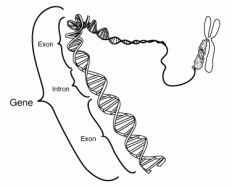 Earlier this month we
asked for examples of instances where claims to isolated DNA interfered with
basic research (see "The Proper Scope of DNA (or "Gene")
Patent Claims"). We posited that the claim would be something
like this one:
An isolated (human) nucleic acid (or
DNA molecule or gene (specified by name)), encoding an amino acid sequence
identified by SEQ ID NO: X,
where the portions
of this claim in parentheses are optional, used in some cases but not necessary
to properly recite the claimed subject matter. This type of claim has the following features:
• It must use the term "isolated" in the claim, to distinguish
it from naturally occurring molecules in their natural state, so as to evince
the "hand of man" in its creation (Diamond v. Chakrabarty)
to satisfy 35 U.S.C. § 101;
• It cannot read on
the natural molecule (i.e., the claim scope cannot be broad enough to encompass
the natural molecule) so that it satisfies the novelty requirement of 35
U.S.C. § 102
(Wood-Paper Patent,
90 U.S. 566 (1874), and Cochrane v. Badische Anilin Soda Fabrik,
111 U.S. 293 (1884));
• Infringement will lie only if the entire
amino acid sequence-encoding isolated nucleic acid recited in the claim is made, used, sold, offered to be
sold, or imported;
• Portions of the gene can be isolated,
sequenced, and characterized and not infringe, and such portions can be changed
and then introduced into the gene to produce another gene that does not
infringe;
• The gene product (typically, a protein)
can be isolated from the cell and studied without infringement, as can
antibodies raised against the gene product; and
• The sequence itself can be identified in
individuals and compared to wildtype or disease-associated mutations without
infringing unless the entire DNA is isolated intact.
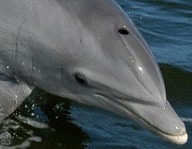 Recent posts provide an opportunity to further distinguish what
is patent eligible from what is not (see "Dolphin Genes Show Relationships
between Large Brains and Energy Metabolism Similar to Humans and Elephants"
and "Genetic
Marker Map of Sunflower Species Reported"). In
the former, researchers have identified a number of genes that have been
subjected to positive selection, presumably due to their usefulness in adapting
to the aquatic lifestyle. This
information was developed by comparing dolphin genes with their orthologs in
related species, including cow, horse, dog, mouse,
elephant, opossum, platypus, chicken, and man. And none of this information is, per se, eligible for patenting, being
(like the capacity for certain species of Rhizobium to grow together) to be "part
of the storehouse of knowledge of all men [and]
manifestations of laws of nature, free to all men and reserved
exclusively to none."
Funk
Brothers Seed Co. v. Kalo Inoculant Co.,
333 U.S. 127 (1948).
However, the paper does posit that
dolphins may be large animal models for type 2 diabetes in humans
During the course of primate evolution, metabolism evolved to provide a
constant supply of energy to the increasing demands of a larger brain.
[Leonard et al., 2003, "Metabolic correlates
of hominid brain evolution," Comp.
Biochem. Physiol. A 136: 5–15]. Humans have evolved several
adaptations, including an increase in visceral fat and the evolution of
tissue-specific insulin resistance in the brain that protects nervous tissue
from energy shortage; however, malfunctions of this system in humans can cause
type 2 diabetes (Kuzawa, 2010 Beyond feast-famine: brain evolution, human life
history, and the metabolic syndrome. In Human evolutionary biology (ed.
Muehlenbein M.), pp. 518–527. Cambridge, UK: Cambridge University Press).
Interestingly, recent research has proposed that dolphins should be seen as a
model for type 2 diabetes, as they possess all the hallmarks of the disease
[Venn-Watson et al., 2011, "Dolphins as animal
models for type 2 diabetes: sustained, post-prandial hyperglycemia and
hyperinsulinemia," Gen. Comp.
Endocrinol. 170: 193–99)]. Here, we find genomic signatures of
adaptive evolution in dolphin genes related to control of food intake such as
genes involved in glycerol uptake and/or glucose metabolism (AQP9, OSTN,
SOCS6), and a neuropeptide AGRP that is expressed in the
hypothalamus and involved in increasing appetite, decreasing metabolism and
regulating leptin. In addition, we found several genes under selection related
to lipid transport and metabolism [] that may be associated with the large fat
reserves found in cetaceans.
Thus, methods for testing compounds as
potential drugs for treating human type 2 diabetes using dolphins may be patent
eligible, in a claim such as this one:
A method for identifying a compound that is effective in treating type 2
diabetes in the human, comprising the step of administering the compound to a
bottlenose dolphin and detecting an antiglycemic effect in the dolphin.
The other paper, on the sunflower genome
identified more than 10,000 genetic loci (by virtue of small nucleotide
polymorphisms or SNPs) to provide a genetic map of the sunflower genome. That genome was represented graphically as
follows:
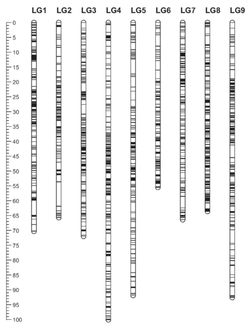
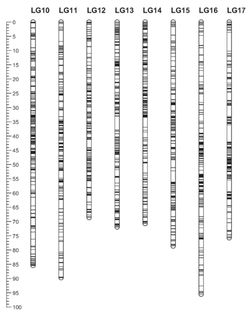
 Like the dolphin genome, this map is also
not patent eligible. However, sunflowers
are of great economic importance, being the fourth largest source of cultivated
vegetable oils worldwide (www.fas.usda.gov). In addition to these maps, the "sunflower
genome project" is under active pursuit (Kane et al. 2011, "Progress
towards a reference genome for sunflower," Botany-Botanique 89:
429–37), wherein genes that may increase yield or resistance to insect
predation or aridity may be mapped to portions of the sunflower genome close to
one of these SNPs. In such a case,
methods for identifying sunflowers having a desirable trait associated with one
of these polymorphisms may be patentable:
A method for producing sunflowers having [a desirable trait], wherein
the trait is genetically linked to [a particular SNP], the method comprising
the step of identifying the SNP in said sunflower and cultivating said
sunflower.
These examples are
not meant to be exhaustive. But they are
intended to illustrate the difference between patent eligible and ineligible
subject matter, and to show that the mere intersection of patents and biology
should not be the occasion to disqualify patent eligible subject matter.
This is illustrated by the drawing below, which discloses relationships between gene expression in mammalian development. If you squint a little looking at the drawing (or click on the image), these inter-relationships look somewhat like a circuit drawing, and in some ways they are. These interrelationships are not, per se, eligible for patenting. But components thereof, and methods taking advantage of the elucidation of these interrelationships should be, and their provenance in the natural world should not be enough to categorically exclude them from patent eligibility.
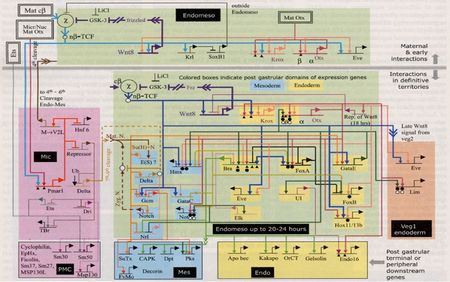 Figure from Ellis, "Animal Evolution: A View from the Genome," Engineering & Science 3/4: 42-51 (2001).


Leave a Reply