
By Kevin E. Noonan —
 The Myriad case (AMP v. USPTO) came to the Federal Circuit on Monday for oral argument, and after months of briefing and public comment the parties did not deviate from their well-established positions (with the possible exception of Solicitor General Neal Katyal, whose argument for the government has become even more extreme than it was in the Department of Justice's amicus brief; see "DOJ Tries to Be All Things to All Constituencies in Myriad Amicus Brief"). But whatever information was to be gleaned from the proceedings came from the judges of the court, in a panel comprising Judges Lourie, Bryson, and Moore.
A large portion of the arguments by Gregory A. Castanias of Jones Day, arguing for appellant Myriad, and Christopher A. Hansen of the ACLU, arguing for the plaintiffs, involved the important (and potentially dispositive) standing issue; those arguments will be the subject of a later post. And except for a few short minutes, when the parties discussed the method claims at issue, the arguments were focused on the principal substantive issue in the case, whether isolated DNA is patent-eligible.
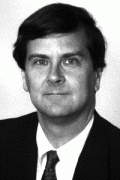
 Mr. Castanias (at left) began his argument with the simple statement that "isolated DNA does not exist in nature." Judge Bryson asked about the scope of the composition of matter claims by asking: "I want to understand the scope of what you think your claim covers," specifically whether sequencing the "entire human genome" would infringe the composition of matter claims. He stated that this is "an important question as to how preclusive your patent is," raising the possibility of having to license "hundreds" or "thousands" of patents to sequence the genome.
While qualifying his answer by saying he was "not sure" Myriad had formed a view on that question, Mr. Castanias properly said that "whole genome" sequencing would not infringe, because the gene would not be isolated (with reference to the USPTO's utility guidelines). He analogized Judge Bryson's hypothetical to the gene residing as it does in nature in the chromosome, and thus being outside the scope of the claim because it is not isolated. Judge Bryson properly noted that "as long as you don't isolate that particular gene" and "do the test on something other than a gene-by-gene sequence" then a party would not infringe.
Judge Bryson then asked about sequencing DNA comprising subject matter encompassed by claims 5 and 6 of the '282 patent, which are directed to the 15 nucleotide oligonucleotide fragments of the claimed BRCA genes:
5. An isolated DNA having at least 15 nucleotides of the DNA of claim 1.
6. An isolated DNA having at least 15 nucleotides of the DNA of claim 2.
Mr. Castanias said sequencing such sequences would also not fall within the scope of these claims as they reside in the chromosome. Judge Lourie asked about isolation methods that separated the coding portion of the genes from introns, which Mr. Castanias said would be covered if the DNA was "isolated."
Mr. Castanias characterized the District Court's decision as reading into the law a "sweeping products of nature exception," which he said the judge attempted to limit to DNA but he predicted would have "consequences for all sorts of areas, including other areas of the biotechnology industry." He admitted to the exceptions to patent eligibility contained in Chakrabarty regarding "a new mineral discovered in the earth or a new plant found in the wild," which provided Judge Moore with the occasion to ask him to distinguish isolating a mineral from a rock, requiring "extensive excavation" or "breaking the bonds" binding the mineral to the other materials in the rock, and asked "how is that really different from isolating DNA." (One of the problems with many of these arguments, as with much of the debate, is that posing such questions disregards intrinsic scientific differences.) Mr. Castanias responded by saying that "on some level," it is not different for § 101 purposes, because the isolated mineral should be eligible for a patent as a composition of matter. He noted that there were other sections of the statute, particularly § 103, that could preclude patentability of the mineral. Judge Moore followed up by noting that under § 103 the mineral would not be patentable if it were extracted using "routine methods," and that "routine methods" were used by geneticists to isolate the BRCA gene, and further that there was nothing "particularly unique" about BRCA1 compared to "the gene for pancreatic cancer or the gene for Alzheimer's or any of these other genes." Mr. Castanias reminded the panel that there were important facts not considered by the District Court, including the state of the art in 1995 when the genes were isolated, that are part of the § 103 analysis but not part of a § 101 patent-eligibility analysis (which he called "a coarse filter").
Persisting in following her hypothetical, Judge Moore asked Mr. Castanias whether the isolated mineral would be a patent-eligible composition of matter, and he replied that it should, "although it presents a close case."
Judge Lourie pointed out that the mineral "is still the mineral" when in the rock, and it is physically but not chemically joined as a different molecular substance, whereas "[a] gene is distinctly different in the isolated state from what it is" in the body, which Judge Lourie says "reflects science in fact." Mr. Castanias agreed, but when he mentioned the "complex efforts" it takes to isolate a gene, Judge Moore asked him to explain the relevance of the difficulty, and Judge Bryson noted that mining can be "difficult" and complex but that shouldn't change the patent-eligibility of diamonds produced by mining. In response, Mr. Castanias tried to relate these efforts to the application of technology, but Judge Bryson asked if the argument was to distinguish between a mineral that was isolated by "breaking covalent bonds" from a mineral that was purified by, for example, "washing it with a solvent" to remove impurities. Mr. Castanias replied that this is the kind of distinctions that are found in the case law, requiring the mineral to be "structurally or functionally different," and if it isn't then § 101 could be used to preclude patent-eligibility.
When Mr. Castanias mentioned the Chakrabarty standard of an invention being the product of human ingenuity, Judge Moore asked why isn't it the process of isolating that is the product of human ingenuity, not the isolated DNA product "that was in your body, saying "God made it, man didn't make it." Mr. Castanias responded with his best analogy, by noting that "only God can make a tree" and yet a baseball bat produced from wood can be patent-eligible, and that in a way that bat is "embedded" in the tree like DNA that is isolated is embedded in a chromosome. Isolated DNA, he says, is not made by God but is the product of "molecular biology" and human ingenuity.
He briefly turned to the method claims, saying that Judge Sweet made "a claim construction error" by considering the term "sequence" in the claims to mean the information represented by the letters of the gene's sequence. Judge Lourie noted that the method claims recite broadly "analyzing, comparing, detecting," which he stated are "thought processes as opposed to concrete steps." Mr. Castanias cited the Prometheus opinion (written by Judge Lourie) as the standard, that is transformative insofar as the claim recites a "determining" step (which Judge Lourie noted was not in these claims). Mr. Castanias replied that a "determining" step was inherently in the claim, by virtue of there being a patient tumor sample and a germline sample ("these are things that are pulled out from a human body") from which the sequence must be determined. He ended his argument by noting that the District Court had invalidated claim 20 of the '282 patent:
20. A method for screening potential cancer therapeutics which comprises: growing a transformed eukaryotic host cell containing an altered BRCA1 gene causing cancer in the presence of a compound suspected of being a cancer therapeutic, growing said transformed eukaryotic host cell in the absence of said compound, determining the rate of growth of said host cell in the presence of said compound and the rate of growth of said host cell in the absence of said compound and comparing the growth rate of said host cells, wherein a slower rate of growth of said host cell in the presence of said compound is indicative of a cancer therapeutic.
He characterized steps such as "growing" in this claim by saying that "if this isn't transformative, I don't know how anything could be."
 Mr. Hansen's (at right) argument for the plaintiffs was that the identity of the sequence in the isolated gene and the gene in the chromosome meant that there was no difference between them (disregarding, as plaintiffs must, the physicochemical differences between isolated and chromosomal DNA). He maintained that "Myriad's entire business is based on isolated DNA being identical to" chromosomal DNA. In support of this assertion, he noted that Myriad analyzes BRCA DNA from a blood sample and when reporting the results does not say that they had "no idea" about the mutational status of the BRCA genes in the native state in the chromosome. Of course, he neglected to mention that the isolated DNA claims would not be infringed merely by determining the sequence from a blood sample, provided the claimed BRCA DNA was not isolated.
Judge Lourie addressed the "mere purification" argument from the District Court. He noted the difference between purifying a chemical compound from a contaminant and isolating the gene from the chromosome, which involves breaking covalent bonds. Mr. Hansen responded that "all" Myriad does is isolate the gene, "snip the gene out of the body." In response to Judge Lourie's objection that "the gene isn't just sitting there" and that it "isn't easy," Mr. Hansen said that Myriad had not invented the methods for obtaining the BRCA gene and that the methods used were "well known in the science." He said the claims were written so that if he could use a pair of tweezers to isolate the gene, then he would infringe. He argued the isolated gene has "the exact same nucleotides" as in the native chromosome, but Judge Lourie interrupted by noting that Mr. Hansen's argument implied that the BRCA gene "was just sitting there" like "diamonds in a mine next to iron and uranium," which was not the case. Mr. Hansen responded by using the metaphor of a kidney in "its natural state" in his body and that surgical removal of the kidney didn't make the kidney patentable (illustrating that bad analogies make bad law), saying that "the fact that the surgeon used a scalpel instead of a chemical is exactly irrelevant."
Judge Bryson said he "was not sure about that," saying that "this gets to a really important issue in the case" for him. Referring to Mr. Castanias' "bat in the tree" analogy ("but in a chemical setting"), Judge Bryson said that "there are many complex molecules that can be changed by lopping off some portion" thereof and "creating another molecule that was, in a sense, embedded in the first molecule" and that "all you have done is broken one or two covalent bonds," thereby "creat[ing] a molecule that does not exist in nature" that "may have functionality that is very different than the original." In response, Mr. Hansen said the law requires that "the new thing we've created has different functions," "markedly different" in "character and kind." He claimed that the isolated DNA is not different, and that "Myriad has offered no explanation and they can't," based on the argument about the identity of the sequence in the isolated DNA and the sequence in the chromosomal DNA (again, ignoring every other difference but the sequence). Judge Bryson countered that the "functionality" difference is that the isolated DNA is "amenable to testing," because "you can't test the DNA . . . in the original form in the body." Mr. Hansen avoided addressing this argument directly, but made another (inapt) analogy, that "you can't use gold when it is in the mountain" to make jewelry and that a kidney is no less a kidney because you cannot use it for transplant when it is in the body. Judge Lourie noted that "even if the functionality is the same" the isolated gene is different because "you've broken covalent bonds" in isolating it from the chromosome. Mr. Hansen's response was that there is no difference between breaking covalent bonds versus "veins or arteries or rocks," saying that the relevant question is whether "the thing once I've taken it out is identical to the thing that was inside," again focusing on the sequence rather than the difference in chemical structure. When Judge Lourie tried to distinguish Mr. Hansen's continued analogy that "half of gold is still gold" by saying "gold is gold," Mr. Hansen responded that "DNA is DNA," which pretty much sums up the level at which the ACLU wishes to keep the discussion.
Judge Moore asked Mr. Hansen whether there was a difference between the "whole gene" and a fragment like cDNA or the oligonucleotide claims. Mr. Hansen said that the specification "makes very clear" that the claims are not limited to cDNA. He refuted patentability based on differences in functionality between the "whole gene" and the "primers and probes" by saying the use of the primers and probes is just the same as they are used in the body, meaning hybridization between complementary strands (again ignoring any of the many distinctions with how primers and probes are actually used).
Turning to the method claims, Mr. Hansen maintained (after Judge Lourie asked him to address the Prometheus case) that the claims would be infringed if the publicly available BRCA sequence and a publicly available whole human genome sequence (using Professor George Church, who has published his entire genome sequence, as an example) were merely compared. Turning to the Prometheus case, he said that the case involved "transformative activity" but that in plaintiffs' view "sequencing DNA does not involve any transformations" because "you don't have to isolate the DNA" in order to infringe. In making this argument, Mr. Hansen of course inadvertently refuted his earlier arguments that the composition of matter claims were in any way relevant to the basis of the lawsuit, since the predicate for the suit was that these claims prevented the plaintiffs from practicing Myriad's claimed methods.
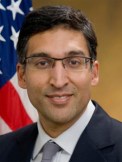 Solicitor General Katyal (at left) presented the government's argument. He began his argument by singling out claim 1 of the '282 patent:
1. An isolated DNA coding for a BRCA1 polypeptide, said polypeptide having the amino acid sequence set forth in SEQ ID NO:2.
as being outside the scope of § 101 as interpreted by the Supreme Court. Mr. Katyal brought to the court the rhetorical device of a "magic microscope," by which he argued that if the DNA as it resided in the chromosome was identical (presumably, in its sequence) as the isolated DNA, it was outside the scope of patent eligibility under § 101. In response to Judge Moore's question regarding the oligonucleotide claims (e.g., claims 5 and 6 of the '282 patent), Mr. Katyal said that the fragment claims would also be "products of nature" if the "magic microscope" could detect those sequences in the chromosome. This reading is contrary to the government's brief, where the synthetic nature of oligonucleotides presumably conferred patent eligibility. cDNA, on the other hand, is patent eligible according to the government because it was not found in nature.
Mr. Katyal characterized the government's position as being "a very limited position," "not a position that . . . is going to dramatically undermine the biotechnology industry or destroy all the patents" raised in amicus briefs. His position was clear and absolute: if the product was found in nature, then it was not patent eligible, based on the government's reading of Supreme Court precedent.
Judge Lourie took issue with the government's characterization of the claimed products in this case as "products of nature," on the grounds that the claimed genes were "bonded to other materials." Mr. Katyal argued that the same could be said for minerals such as lithium, which "exist as salts with covalent bonds," but that "nobody would think that the third element in the periodic table" could be patentable because it doesn't exist in nature. He argued that finding that an isolated gene was patent-eligible would be equivalent to finding that an "isolated electron" was patentable. The extent to which the government is willing to maintain their position became clear when Mr. Katyal used the example of a discovery that pollen from a particular plant provided a cure for cancer, but that the purified pollen would not be patent eligible. (Unmentioned was the more relevant hypothetical of a chemical compound isolated from that pollen.) Mr. Katyal did agree with Judge Lourie that the legal basis for the District Court's opinion, that isolated DNA was the "physical embodiment of [genetic] information," was not correct and that the government did not support it.
Mr. Katyal advanced the argument that there is "a cardinal distinction for 101 purposes between products of nature . . . and human-made invention, and the mere act of isolating a substance doesn't mean that it is a human made invention," based on the government's interpretation of Supreme Court precedent (which he seemed not to recognize is murky at best).
In response to Judge Bryson's questioning about the differences between purifying (separating a molecule from impurities) and isolating (breaking bonds to convert one substance into another), Mr. Katyal cited breaking "covalent" bonds in purifying lithium or "breaking bonds" when uranium 238 is changed to uranium 235 in support of his patent-ineligibility argument (at which point Judge Lourie kindly suggested that the argument was entering into "facts (sic)" outside the record).
Judge Moore raised "B12" and more importantly "antibodies" as examples of "products of nature" that would be patent-ineligible under the government's view. Mr. Katyal maintained that the "earlier cases" all held that products of nature were "not patent-eligible" without acknowledging the effects the government's position can be expected to have. He rebutted the examples in some of the briefs, notably taxol, because it was not patented (an outcome having to do not with patent ineligibility but with prior art issues which he failed to note). He contended that process patents would be sufficient to "provide the correct incentives" for innovation (without citing any evidence for this proposition). He also seemed to agree with the plaintiffs that claim 1 of the '282 patent and claim 1 of the '492 patent:
1. An isolated DNA molecule coding for a BRCA2 polypeptide, said DNA molecule comprising a nucleic acid sequence encoding the amino acid sequence set forth in SEQ ID NO:2.
were patent-ineligible because the isolated DNA "has the same function as they did in the body" (basing patent eligibility on functional rather than a structural grounds).
When Mr. Katyal stated that the government's interpretation of the law wasn't a dramatic change that "undoes things," Judge Moore vigorously disagreed. She noted that the PTO has been granting isolated gene patents "for 35 years" so that the position Mr. Katyal was advocating was in fact a significant change. Mr. Katyal argued that "the vast majority" of the isolated gene patents the PTO has granted are directed to "cDNA, recombinant DNA" and the like and thus were properly granted, but Judge Moore cited the PTO's Utility Guidelines as expressly reciting isolated genomic DNA as being patent-eligible subject matter. Noting that those Guidelines have not been rescinded by the Office, she concluded that patent-eligibility for isolated genes appears to continue to be the PTO's view. She noted that Mr. Katyal purported to be representing the government but that there seems to be a "split in the government" due to these inconsistencies.
Mr. Katyal then revealed that the District Court decision in this case, as well as Judge Dyk's improvident concurrence in the Intervet case, prompted the government to conduct a "high level, comprehensive review" "for the first time" of patent eligibility of isolated DNA (which clearly expanded to all "products of nature"). He said that the U.S. government's opinion was that the PTO's grant of isolated DNA claims that encompassed genomic DNA was wrong: "we couldn't write a brief that allowed the patentability of isolated DNA, for to do so would be to make lithium patentable, uranium, coal from the earth . . . and perhaps even base individual nucleotides . . . and we just couldn't do that." He also characterized the PTO's input into this decision as not a thumb but an "elbow" on the scale.
Judge Moore then raised the question of whether the Court should be the avenue for making this policy change, and that Congress should speak to this issue. She said that she was "a little nervous" about expanding the number of exceptions to patent eligibility under § 101 "in light of 35 years of industry development" and "in light of a split in the executive" on this issue, asking "why isn't stare decisis a concern?" Mr. Katyal said that the government had made a similar analysis and decided that this was "a pure question of law" and that "Congressional acquiescence alone" was not enough for the government to defer to Congress on this issue. (Unspoken was the financial liability the government would face under the Takings Clause if Congress or the executive branch, rather than the courts, made such a sea change in the law after "35 years" of isolated DNA patents.)
On rebuttal, Judge Moore carried out a line of questioning of Mr. Castanias regarding whether difficulty in isolating the gene should have any relevance to patent eligibility, but Mr. Castanias brought the argument back to the differences in utility based on citations to the record. Rebutting the Solicitor General's arguments ('you don't have to engage in the line drawing the Solicitor General asks you to"), he cited the J.E.M. Ag. Supply v. Pioneer Hybrid case for the proposition that "Section 101 has been consistently understood by Congress and the . . . relevant agency with expertise as encompassing isolated DNA," and that "the PTO and the entire biotech industry has been moored on the notion that isolation is enough to the human invention that's required."
In response to Judge Bryson's question, Mr. Castanias argued that purified lithium should be patent eligible because it has "new utilities" not found in nature. And he finished his rebuttal argument by emphasizing that the isolated DNA is not the entire sequenced genome," based on explicit citations in the patents-in-suit.
As with most arguments, this one was replete with hypotheticals and questions from the bench intended to stretch the boundaries of the arguments to identify weaknesses and inconsistencies. The arguments in general suffered from the tendency to argue from analogies that were tenuous to the subject matter at issue and in some instances completely inapt. If the Federal Circuit reaches the substantive issues discussed herein, it is likely to be subject to en banc review, a petition for certiorari to the Supreme Court, or both. The case is far from over.
For information regarding this and other related topics, please see:
• "Federal Circuit to Hear Argument in AMP v. USPTO," April 3, 2011
• "Curiouser and Curiouser," February 16, 2011
• "AMP v. USPTO — Briefing Update III," February 8, 2011
• "Amicus Briefs in AMP v. USPTO: AARP," January 27, 2011
• "AMP v. USPTO: Appellees' Brief," January 12, 2011
• "AMP v. USPTO — Briefing Update II," December 16, 2010
• "Amicus Briefs in AMP v. USPTO: Alynylam Pharmaceuticals, Inc.," December 15, 2010
• "The Relevance of Patent Exhaustion in the Myriad Genetics Case," December 14, 2010
• "AMP v. USPTO — Briefing Update," December 14, 2010
• "Amicus Briefs in AMP v. USPTO: University of New Hampshire School of Law," December 12, 2010
• "Amicus Briefs in AMP v. USPTO: Rosetta Genomics & George Mason University," December 8, 2010
• "Academic Amici Refute ACLU Falsehoods in Gene Patenting Debate," December 7, 2010
• "Amicus Briefs in AMP v. USPTO: Genetic Alliance," November 10, 2010
• "BIO and AUTM File Joint Amicus Brief in AMP v. USPTO," November 9, 2010
• "AIPLA Submits Amicus Brief in AMP v. USPTO," November 3, 2010
• "IPO Files Amicus Brief in AMP v. USPTO," November 2, 2010
• "AMP v. USPTO — Briefing Update," November 1, 2010
• "DOJ Tries to Be All Things to All Constituencies in Myriad Amicus Brief," October 31, 2010
• "Myriad Files Appeal Brief in AMP v. USPTO," October 28, 2010
• "AMP v. USPTO — Briefing Schedule Update," August 22, 2010
• "FCBA Submits Amicus Brief on Motion for Recusal in AMP v. USPTO," August 9, 2010
• "Appellees Move for Recusal of Chief Judge Rader in AMP v. USPTO Appeal," July 19, 2010
• "AMP v. USPTO after Bilski v. Kappos," July 6, 2010
• "Myriad Appeals AMP v. USPTO Decision," June 16, 2010
• "AMP v. USPTO: What Everyone Else Is Saying – Part II," June 8, 2010
• "AMP v. USPTO: What Everyone Else Is Saying," April 6, 2010
• "'60 Minutes' and 'Newshour' Take Different Approaches to Covering Gene Patenting Story," April 5, 2010
• "'60 Minutes' Examines Gene Patenting Issue on Sunday, April 4th — Patent Docs Author Kevin Noonan to Appear on Program," April 2, 2010
• "AMP v. USPTO: What the Parties Are Saying About the Decision," April 1, 2010
• "Caught in a Time Warp: The (In)validity of BRCA1 Oligonucleotide Claims," March 30, 2010
• "Round One Goes to the ACLU," March 29, 2010
• "USPTO Asks out of Gene Patenting Case (Again)," January 19, 2010


Leave a Reply