
By Kevin E. Noonan —
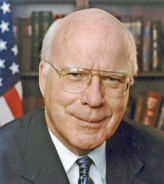 On Tuesday, for the second day in a row, Senator Patrick Leahy (D-VT) (at right) stood on the floor of the Senate and argued for his colleagues to pass S. 23, now named the "Invent America Act." In Tuesday's action (which can be seen here: Senate Session, Part I and Senate Session, Part 2), Senator Leahy introduced a Manager's Amendment (the reported provisions of which are summarized below). In addition, Senator Mark Kirk (R-IL), joined by Senator Mark Pryor (D-AR), introduced an amendment (S.AMDT.123) to provide a fast lane for small businesses within the USPTO, while Senator DeMint (R-SC) introduced an amendment not germane to patent law. Senator Leahy, while yielding to permit these amendments to be entered, insisted in each instance that the Manager's Amendment be the amendment under consideration by the Senate at all times.
The Manager's amendment is expected to have the following effects:
• Change the title of S. 23 to the "America Invents Act"
• Change the date of the repeal of statutory invention registrations, which are used only in first-to-invent, to conform to the date of the change to first-inventor-to-file.
• Strike all damages language remaining in the bill — including the gatekeeper, sequencing, and recodification of current law as subsection (a) which was the "grand compromise" brokered in the last Congress by Senator Dianne Feinstein (D-CA), then-Senator Arlen Spector (R, then D-PA), and Senator Leahy. The bill now makes no changes to 35 U.S.C. § 284; this turn of events is ironic, in view of the importance of changes to this section in motivating support and providing the genesis for patent reform.
• Regarding the post-grant review provisions, replace the subsection imposing a six-month deadline on filing after litigation is commenced with a provision requiring a court to consider a preliminary injunction without taking the existence of either a petition or post-grant review proceeding into account if the patent owner sues within 3 months of the issuance of patent.
• Limit the post-grant review provisions to only "first-inventor-to-file" patents — i.e., "first-to-invent" patents will not be subject to post-grant review. The rationale for this change is that first-to-invent patents raise discovery-intensive invention-date and secret-prior-art issues that would be difficult to address in an administrative proceeding. This also facilitates PTO institution of the post-grant review regime. In light of this change, the time for implementing post-grant review is moved back to one year after enactment, so that it becomes effective at the same time other provisions of the new law are implemented, which is what the PTO is said to prefer.
• Give the Director discretion to continue to use old inter partes reexam during the first four years after the new law is implemented. The Director believes his reforms in the Office have greatly improved the existing inter partes procedure, and it may actually work more efficiently. The existing inter partes procedure can also be used for post-grant review proceedings that are instituted only on the basis of patents and printed publications.
• Strike the codification of the In re TS Tech USA Corp. case regarding transfer-of-venue rule. TS Tech already applies as a matter of case law in the Fifth Circuit. (The Federal Circuit applies regional circuit law to procedural matters, and reads Fifth Circuit law as applying the transfer of venue rule.) Complaints about venue generally focus on the Eastern District of Texas, so there is little need to apply TS Tech nationally or by Act of Congress.
• Add a new provision requiring the Director to charge reduced fees to small entities for use of accelerated examination.
• Add language making clear that the repeal of the Baldwin rule (which rule requires Federal Circuit judges to live within 50 miles of Washington, D.C.) shall not be construed to require the Administrative Office of the Courts to provide judges with office space or staff outside of D.C.
• Broaden the definition of "microentity," a status that entitles applicants to reduced fees (purportedly with PTO approval).
• In the tax patents section, add language: (1) clarifying that the legislation does not bar patenting of tax software that is novel as software — i.e., where the innovation is in the software, although this may not survive to final passage; and (2) establishing that making tax strategies unpatentable shall not be construed to imply that other business methods are patentable or valid. This is intended to avoid the implication from Bilski v. Kappos (2010), where the Supreme Court interpreted Congress's 1999 enactment of a prior-user right that only applied against business-method patents as implying that business methods qualify as patentable subject matter under § 101, which was enacted in 1793.
• Add language to the part of the bill regarding the Surpreme Court's decision in Holmes Group v. Vornado Air Ciculation System allowing removal of patent cases from state to federal court to clarify that derivative jurisdiction is not required in such cases. (Derivative jurisdiction is the doctrine that, even if a federal district court would have had original jurisdiction over an action, on removal, the district court can only have jurisdiction if the state court from which the action is removed properly had jurisdiction.)
• Include the Schumer-Kyl business-methods amendment, modified to accommodate industry concerns and PTO needs. The Schumer amendment provides for a proceeding that is a relatively cheap alternative to civil litigation for challenging these patents, which will reduce the burden on the courts of dealing with invalid business-method patents. The proceeding has been limited since mark up so that: (1) only defendants or accused infringers may invoke the proceeding; (2) prior art is limited to existing § 102(a), which must be publicly available, or prior art of existing § 102(b) scope that falls outside the existing § 102(b) grace period (i.e., effectively, existing § 102(b) prior art but limited to existing § 102(a)'s publicly-available prior-art scope); (3) the proceeding may not be used to challenge a patent while it is eligible for a post-grant review challenge (i.e., a "first-inventor-to-file" patent during the first 9 months after its issue); (4) the proceeding is available only for four years; (5) district courts can decide whether to stay litigation based on the four-factor Broadcast Innovation v. Charter Communications test, and the Federal Circuit can review the decision to stay on interlocutory appeal to ensure consistent application of established precedent; (5) the definition of business-method patent, which tracks the language of Class 705, is limited to data processing relating to just a financial product or service (rather than also to an enterprise.
• Give the PTO greater flexibility in paying and compensating the travel of APJs. A large number of APJs will need to be recruited, trained, and retained to adjudicate post-grant review and derivation actions. This change's enhancements will be paid for out of existing funds.
• Include the Coburn amendment ending fee diversion. Currently, PTO fees go into a Treasury account and are only available to the Office as provided in appropriations. In the last two decades, about $800 million in PTO user fees has been diverted from PTO to other federal spending. The Coburn amendment creates a revolving fund, giving PTO direct access to its fees without the need for enactment of an appropriations act.
In addition, in a separate amendment, the Office is authorized to set its own fees:
(1) IN GENERAL.–The Director shall have authority to set or adjust by rule any fee established, authorized, or charged under title 35, United States Code, and the Trademark Act of 1946 (15 U.S.C. 1051 et seq.), notwithstanding the fee amounts established, authorized, or charged thereunder, for all services performed by or materials furnished by, the Office, provided that patent and trademark fee amounts are in the aggregate set to recover the estimated cost to the Office for processing, activities, services, and materials relating to patents and trademarks, respectively, including proportionate shares of the administrative costs of the Office.
 The amendment passed on a vote of 97-2. Senators Jon Kyl (R-AZ) and Amy Klobucher (D-MN) spoke in favor of the bill and the Manager's Amendment, with neither exhibiting any particular understanding of the issues. Debate continued today, with Senator Feinstein (D-CA) introducing an amendment to strip the bill of the first-inventor-to-file provisions (Patent Docs will have more on this debate in a subsequent post). (When the Senate gets through with this bill, there may not be much left.)
In view of the amendments, the principal changes constituting "patent reform" will be the change to first-inventor-to-file and post-grant review, both of which have raised concerns from sole inventors and small businesses as having a disproportionately negative effect (see "More Reaction to Senate Patent Reform Legislation"). These complaints suggest that, as has happened before, interests who believe this bill will harm their capacity to innovate should make their views known to their Senators.


Leave a Reply