
By Donald Zuhn —
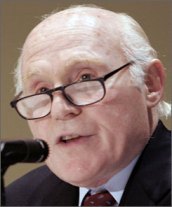 Last week, Senator Herb Kohl (D-WI) (at right) introduced the Preserve Access to Affordable Generics Act (S. 27) in the Senate. The bill, which is co-sponsored by Senators Sherrod Brown (D-OH), Susan Collins (R-ME), Richard Durbin (D-IL), Al Franken (D-MN), Chuck Grassley (R-IA), Amy Klobuchar (D-MN), and Bernard Sanders (I-VT), is designed to prohibit brand name drug companies from compensating generic drug companies for delaying the entry of generic drugs into the market.
In a section entitled "Findings," the bill notes that "[p]rescription drugs make up 10 percent of the national health care spending but for the past decade have been one of the fastest growing segments of health care expenditures." The bill states that "[u]ntil recently, the [Drug Price Competition and Patent Term Restoration Act (or Hatch-Waxman Act)] was successful in facilitating generic competition to the benefit of consumers and health care payers — although 67 percent of all prescriptions dispensed in the United States are generic drugs, they account for only 20 percent of all expenditures." According to the bill, "[i]n recent years, the intent of the [Hatch-Waxman] Act has been subverted by certain settlement agreements between brand companies and their potential generic competitors that make 'reverse payments' which are payments by the brand company to the generic company." The bill asserts that "[t]hese settlement agreements have unduly delayed the marketing of low-cost generic drugs contrary to free competition, the interests of consumers, and the principles underlying antitrust law," and contends that "[b]ecause of the price disparity between brand name and generic drugs, such agreements are more profitable for both the brand and generic manufacturers than competition, and will become increasingly common unless prohibited."
The bill would allow the Federal Trade Commission to initiate an enforcement proceeding "against the parties to any agreement resolving or settling, on a final or interim basis, a patent infringement claim, in connection with the sale of a drug product." In such proceedings, "an agreement shall be presumed to have anticompetitive effects and be unlawful if — (i) an ANDA filer receives anything of value; and (ii) the ANDA filer agrees to limit or forego research, development, manufacturing, marketing, or sales of the ANDA product for any period of time," unless "the parties to such agreement demonstrate by clear and convincing evidence that the procompetitive benefits of the agreement outweigh the anti-competitive effects of the agreement." The bill lists a number of factors to be considered in determining whether the parties to the agreement have met the above burden. The bill also provides a number of penalties for violating the Act, including a civil penalty in the amount of three times the value received by an NDA holder or given to an ANDA filer that is in violation of the Act.
Senator Kohl's bill is similar to the bill (S. 369) that he introduced in the last Congress, which would have added a new section to The Clayton Act (15 U.S.C. 12 et seq.) that would have made it unlawful "for any person, in connection with the sale of a drug product, to directly or indirectly be a party to any agreement resolving or settling a patent infringement claim in which — (1) an ANDA filer receives anything of value; and (2) the ANDA filer agrees not to research, develop, manufacture, market, or sell the ANDA product for any period of time" (see "Bill to Prohibit Reverse Payments Introduced in the Senate"). When introducing S. 369, Senator Kohl called reverse payment agreements "backroom" deals that constitute "one of the most egregious tactics used to keep generic competitors off the market." The new bill marks the third straight Congress in which Senator Kohl has introduced legislation intended to prohibit reverse payments.


Leave a Reply