
By Donald Zuhn —
 Last week, in Cancer Research Technology Ltd. v. Barr Laboratories, Inc., the Federal Circuit reversed the decision by the District Court for the District of Delaware holding U.S. Patent No. 5,260,291 unenforceable for prosecution laches and inequitable conduct. Judge Lourie, writing for the Court and joined by Judge Newman, held that the unreasonable and unexplained delay requirement of the prosecution laches defense includes a finding of prejudice, and that an accused infringer must show evidence of intervening rights — i.e., that either the accused infringer or others invested in, worked on, or used the claimed technology during the period of delay — in order to establish such prejudice. With respect to the District Court's finding of inequitable conduct, the majority determined that the District Court erred because it relied solely on its finding of materiality to infer intent. Judge Prost dissented from the opinion of the Court.
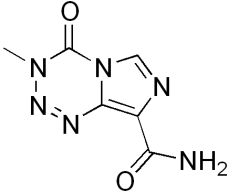 Plaintiff-Appellant Cancer Research Technology Ltd. ("Cancer Research") owns the '291 patent, which relates to a genus of tetrazine derivative compounds and methods for treating cancer by administering those compounds. The '291 patent identifies and characterizes thirteen tetrazine derivative compounds, including temozolomide (structure at left), which is the active ingredient in the cancer drug Temodar®, and mitozolomide, which the '291 patent describes as having "particular importance." The '291 patent issued following more than eleven years of prosecution during which time eleven continuing applications were filed by the applicants. With respect to most of the applications in the chain, applicants "responded" to the rejection of original claim 31 for lack of utility by filing a continuation application and abandoning the rejected application. Cancer Research obtained ownership of the application for the '291 patent after ten of the eleven applications in the chain had been filed, filed one last continuing application, and challenged the utility rejection by arguing that animal data in the original specification sufficed to establish utility in humans. The '291 patent subsequently issued. In the eleven years during which the '291 patent was being prosecuted, one of the inventors co-authored several papers reporting animal and human clinical data for the tetrazine derivative compounds of the '291 patent, including data for mitozolmide, which showed the compound to have little activity against many cancers.
 Seeking approval to market a generic version of Temodar®, Defendants-Appellees Barr Laboratories, Inc. and Barr Pharmaceuticals, Inc. ("Barr") filed an Abbreviated New Drug Application (ANDA) with the FDA. In response to Barr's ANDA filing, Cancer Research brought suit against Barr for infringement of the '291 patent. The parties stipulated to infringement and validity of claim 13, which is directed to temozolomide, leaving Barr's counterclaims of unenforceability for prosecution laches and inequitable conduct for trial.
Following a bench trial, the District Court held the '291 patent unenforceable for both prosecution laches and inequitable conduct. With respect to the first issue, the Court determined that prosecution laches turned on whether Cancer Research's delay in prosecuting the '291 patent was unreasonable and unexplained under the totality of the circumstances, but did not require a showing of intervening rights. The Court found that the delay caused by eleven continuation applications, ten abandonments, and no substantive prosecution for nearly a decade was unreasonable and a sufficiently egregious misuse of the patent system to bar enforcement of the '291 patent for prosecution laches. With respect to the second issue, the Court determined that Cancer Research failed to disclose, inter alia, Phase I and II human data indicating that mitozolomide failed to treat numerous cancers to the Patent Office, and that this information was highly material because it directly contradicted statements in the '291 patent and directly contravened the patentability of claim 28. The Court also determined that there was an intent to deceive because one of the inventors withheld highly material information, knew or should have known that the materiality contradicted the '291 disclosure, and did not provide a credible explanation for withholding the information.
On appeal, Cancer Research argued that the doctrine of prosecution laches requires both an unreasonable and unexplained delay in prosecution and prejudice based on the intervening rights of the defendant or the public during the period of delay, and that the District Court erred in holding the '291 patent unenforceable for prosecution laches because the Court failed to find any evidence of actual prejudice either to the defendant or the public. Barr responded by arguing that the District Court correctly recognized that the defense of prosecution laches does not require a specific showing of prejudice.
 In reversing the District Court's finding of unenforceability for prosecution laches, the majority determined that prosecution laches' requirement of an unreasonable and unexplained delay includes a finding of prejudice, and declared that "[w]e . . . now hold that to establish prejudice an accused infringer must show evidence of intervening rights, i.e., that either the accused infringer or others invested in, worked on, or used the claimed technology during the period of delay." In support of this holding, the majority cited four Supreme Court cases which the majority stated "all rely on a finding that the applicant's delay in prosecution adversely affected others working in the same field": Woodbridge v. United States, 263 U.S. 50 (1923); Webster Electric Co. v. Splitdorf Electrical Co., 264 U.S. 463 (1924); Crown Cork & Seal Co. v. Ferdinand Gutmann Co., 304 U.S. 159 (1938); and General Talking Pictures Corp. v. Western Electric Co., 304 U.S. 175 (1938). The majority also pointed to Symbol Techs., Inc. v. Lemelson Med., 277 F.3d 1361 (Fed. Cir. 2002) ("Symbol Techs. I"), for support, stating that:
In first recognizing the doctrine, we relied on the above-cited Supreme Court cases and noted their reliance on intervening rights. Symbol Techs. I, 277 F.3d at 1364-65. For example, we stated that in Crown Cork, "the [Supreme C]ourt ratified the existence of the prosecution laches defense; it did not apply the defense there in the absence of intervening rights," and we noted that "in General Talking Pictures, the Court rejected the defense of prosecution laches because there was no evidence of intervening public rights." Id. at 1365. We then applied the doctrine in a manner that recognized the requirement for intervening rights. We held that the district court had not abused its discretion in holding certain patents unenforceable for prosecution laches based on the applicant's unreasonable delay and "the existence of 'intervening private and public rights.'" [Symbol Technologies, Inc. v. Lemelson Medical, 422 F.3d 1378, 1386 (Fed. Cir. 2005)]. We also extended the holding to all the remaining claims based on finding that the subject matter of all the asserted patents had been pending for eighteen to thirty-nine years, an unreasonably long time, and that "prejudice to the public as a whole has been shown here in the long period of time during which parties, including the [declaratory judgment] plaintiffs, have invested in the technology described in the delayed patents." Id.
Applying its holding to the instant appeal, the majority stated that:
Barr . . . while entitled under the law to file an ANDA four years after the NDA approval, in this case in 2003, did not do so until 2007. Thus, Barr filed its ANDA more than thirteen years after the issuance of Cancer Research's patent and more than seven years after approval of Cancer Research's product. Barr was thus hardly prejudiced by the delay in the issuance of the '291 patent, in 1993. Nor was anyone else. There has been no evidence presented that anyone was deterred from entering the market for temozolomide because Cancer Research's patent issued in 1993 rather than several years earlier. Thus, the delay had only limited consequences to Barr and the public.
The majority observed that "Cancer Research's delay in prosecuting and issuing its patent application, whatever the asserted justifications, and we do not appraise them here, caused it to run the risk that some other pharmaceutical company (e.g., Barr) would intervene and claim prejudice from the delay, but that did not happen." The Court also noted that "the facts of this case are not likely to be frequently repeated, as patent terms are now measured from effective filing date, . . . subject to only limited extensions provided by statute, not by delaying issuance by refilling."
With respect to inequitable conduct, Cancer Research argued that the District Court erroneously relied solely on its finding of materiality to infer deceptive intent, and therefore, erred in finding that one of the inventors withheld studies on tetrazine derivatives with deceptive intent. Barr argued in response that that the District Court correctly found that the inventor knew he possessed undisclosed data that contradicted the disclosure in the patent application, and knew he had a duty to disclose such material information to the Patent Office, but did not do so. According to Barr, the only reasonable inference that could be drawn from this was an intent to deceive. In reversing the District Court's finding of unenforceability for inequitable conduct, the majority determined that "the district court erred because it relied solely on its finding of materiality to infer intent." In particular, the majority noted that:
[M]ateriality and intent are separate requirements, and intent to deceive cannot be found based on materiality alone. Larson Mfg. Co. of S.D., Inc. v. Aluminart Prods. Ltd., 559 F.3d 1317, 1340 (Fed. Cir. 2009). A court cannot simply infer that an applicant "should have known" the materiality of withheld information and thus intended to deceive the PTO because the applicant knew of the information and the information is material. A district court must find some other evidence that indicates that the applicant appreciated the information's materiality. See, e.g., Critikon, Inc. v. Becton Dickinson Vascular Access, Inc., 120 F.3d 1253, 1256 (Fed. Cir. 1997) (finding intent to deceive based in part on handwritten notes of prosecution counsel corroborating that counsel subjectively believed the undisclosed patent was material). In this case, evidence that [an inventor] co-authored articles that contradict the disclosure of the '291 patent specification does not alone establish that [the inventor] withheld those studies intending to deceive the PTO.
As for other reasonable inferences that could be drawn from the inventor's publication of contradictory data, the majority surmised that "an equally reasonable inference to draw from the evidence is that [the inventor] viewed publication of all the data as important to his career as a scientist but did not appreciate their potential importance to the patentability of the tetrazine derivatives patent claims."
In her dissent, Judge Prost declared that "the majority propounds a new and unsupportable legal standard for prosecution laches" and "creates a new evidentiary standard [for inequitable conduct," while] it also ignores virtually unassailable credibility findings made by the district court after a four-day bench trial." On the issue of prosecution laches, Judge Prost argued that the District Court "got it right" because the Court's precedent does not compel a showing of intervening rights, adding that "even if one could construe the case law as requiring prejudice, there is no basis, in the relevant case law or otherwise, for the majority’s further temporal limitation that the prejudice exists during the period of delay." The dissent noted that:
By requiring this particularized prejudice, the majority sidesteps the real harm at issue in this case. The Supreme Court has explicitly recognized that delaying a patentee's monopoly period harms the public by delaying its free use of the patented invention. Woodbridge, 263 U.S. at 48-49. Here, the applicant first filed the patent application disclosing temozolomide in 1982. By stalling prosecution for its own business purposes for nearly a decade, Cancer Research obtained a patent which does not expire until 2014 — almost thirty-two years after the first application in this chain was filed. The majority downplays the public prejudice caused by this delay, Maj. Op. at 12-13; however, Cancer Research's conduct has prejudiced the public by extending its patent monopoly over temozolomide.
On the issue of inequitable conduct, Judge Prost stated that:
Again, in my view, the district court got it exactly right. Here, an inventor . . . withheld important data from the U.S. Patent and Trademark Office ("PTO") that contradicted the disclosure in the patent applications. The majority does not take issue with the district court's conclusion that this data was highly material. Clearly, it could not, because at a minimum the disclosure would have affected the scope of the patent granted. Rather, it rejects the district court's credibility determination that [the inventor's] explanation for not submitting this highly material data was belied by the facts that [the inventor] found the data conclusive enough (and sufficiently non-confidential) to publish the data and his conclusions of inactivity or toxicity to the scientific community.
The dissent concluded by arguing that "[r]equiring separate evidence for each prong [i.e., materiality and intent to deceive,] has no basis in our precedent."
Cancer Research Technology Ltd. v. Barr Laboratories, Inc. (Fed. Cir. 2010)
Panel: Circuit Judges Newman, Lourie, and Prost
Opinion by Circuit Judge Lourie; dissenting opinion by Circuit Judge Prost


Leave a comment