
By Donald Zuhn —
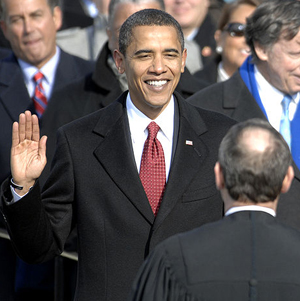
Earlier today, in a historic moment on the steps of the U.S. Capitol, Barack Hussein Obama was sworn in as the 44th President of the United States. Tomorrow, his Administration will begin to tackle the many serious issues that face our country (the Administration's agenda can be found on the newly revamped White House website). While fixing the U.S. patent system — to the extent that it needs to be fixed — will need to take a back seat to fixing the economy in the coming months, President Obama and Congress will likely turn their attention to patent reform later this year (the President's goals for the U.S. patent system can be found on the Technology page of the White House website).

Last Friday, The Heritage Foundation, a conservative public policy research institute, joined the ranks of organizations and trade groups that have offered the Obama Administration suggestions for reforming the U.S. patent system. In a publication entitled: "Promoting Innovation with Patent Reform: A Memo to President-elect Obama," Senior Legal Policy Analyst Andrew Grossman asked the President "to consider the patent system's flaws in the context of its broad, unparalleled success" when making changes. Suggesting that the Obama Administration and Congress "favor narrower reforms that target specific flaws and shortcomings," Mr. Grossman specifically proposes that the President:
• Reject "reforms" that reduce the certainty of intellectual property;
• Improve patent quality; and
• Reject proposals that would undermine investment in innovative biologic drugs.

With respect to the first objective, Mr. Grossman (at right) warns that "[s]pecial interests are angling for advantage within America's patent system," and advises the new Administration to avoid implementing additional limits on remedies for patent infringement or further restrictions on injunctive relief. In recognition of the efforts by the IT industry and the Coalition for Patent Fairness to convince Congress to include an apportionment of damages provision in patent reform legislation, Mr, Grossman states that "patent reform must adopt a consensus approach that does not favor any one industry's or coalition's narrow agenda," adding that "[p]laying favorites with the patent system is risky and likely to fail, both politically and economically."
Some of the paper's most interesting proposals are presented in the portion of the memo that addresses the second objective. First, Mr, Grossman asks the President to "strictly limit" the window within which a patent could be challenged, and the parties that would be allowed to initiate such a challenge, under any new post-grant review process. He contends that "[w]ithout these protections, additional post-grant review procedures are likely to weaken property rights without significantly reducing litigation." Next, Mr. Grossman tackles the inequitable conduct doctrine, advising that "the doctrine's great costs and limited deterrent value counsel its elimination or restriction." Absent elimination of the doctrine, the memo endorses the approach taken by the Kyl patent reform bill (S. 3600), in which initial determinations of inequitable conduct are referred to the Patent Office in order to reduce the burden of fully litigating the issue in court (see "Senator Kyl's Patent Reform Bill Introduced Today").
Regarding the third objective, Mr. Grossman suggests that the President provide adequate resources to the Patent Office by asking Congress to give the Office permanent authority to keep all of its fees, as well as the authority to set its fees. In addition, the memo seeks revision of the patent production system, contending that "the system encourages examiners to spend too little time on most applications, to cut short the examination of complex applications disproportionately, and to shortchange initial examinations in favor of continuation applications." The paper also proposes other "minor" reforms, including regular pre-search and pre-first action interviews and financial incentives for applicants who elect to defer examination or abandon applications prior to search or examination.
While Mr. Grossman notes that the last objective relates more to the establishment of a follow-on biologics regulatory pathway, he nonetheless offers its advice concerning an appropriate data exclusivity period under such a pathway. Stating that "[w]ithout adequate data exclusivity, innovation in the biotech sector will dry up, leading to fewer lifesaving treatments and eroding America's leadership in this field," he advises against "[i]mposing a short exclusivity period or otherwise limiting enforcement of biologic patents." Interestingly, while exclusivity periods of between 0-14 years have been proposed in various follow-on biologics bills introduced in the House and Senate, the paper only specifically mentions the 14-year period.
Mr. Grossman concludes by stating that:


Leave a Reply