
By Kevin E. Noonan —
There are the inklings of a stratagem taking shape in certain of the Federal Circuit's decisions since the spate of Supreme Court rejections of large portions of its jurisprudence. That stratagem involves refusing to overturn district court decisions based on applying an abuse of discretion standard, as evidenced in the Federal Circuit's decision to affirm grant of a permanent injunction in Acumed LLC v. Stryker Corp.
The case involved a patent to an orthopedic nail used to reconstruct and stabilize a broken humerus. The CAFC previously vacated a permanent injunction granted prior to the Supreme Court's decision in eBay Inc. v. MercExchange, L.L.C., which mandated that the traditional "four factor" test for granting injunctions was to be applied in patent cases. This mandate overruled the Federal Circuit's "general rule [in patent cases] that an injunction will issue, once infringement and validity have been adjudged . . . unless there are some exceptional circumstances that justify denying injunctive relief." Thus, the District Court revisited the issue based on a proper application of the law and arrived at the same conclusion.

In making its determination that a permanent injunction was permissible in this case, the District Court considered together the four-factor test prongs of whether there was irreparable harm to patentee Acumed and whether the remedy at law (money damages) was adequate compensation as a remedy. Stryker presented evidence that Acumed previously had granted licenses for the patent-in-suit (U.S. Patent No. 5,472,444) to two other competitors, Smith & Nephew and Zimmer. The District Court distinguished this behavior on the grounds that, first, Acumed had granted the Smith & Nephew license to settle litigation, and second, that Zimmer was not direct competitor when Acumed granted it a license.

The Federal Circuit, in a unanimous opinion written by Judge Lourie and joined by Judges Mayer and Gajarsa, found none of this to be an abuse of discretion. The Court asserted that eBay itself stated that a patentee's willingness to license patents to others was not sufficient by itself to preclude a determination that a patentee would be irreparably harmed or that money damages would be an insufficient remedy. The Court asserted that prior licenses were but one factor a court could consider in deciding whether the evidence favored vel non grant of a permanent injunction. "Adding a new competitor to the market may create an irreparable harm that the prior licenses did not," according to the Court. In a footnote, the Court noted that it did not consider whether an injunction would be appropriate in other circumstances where a patentee had granted licenses to third parties, thus avoiding creation of any per se rules in this regard.
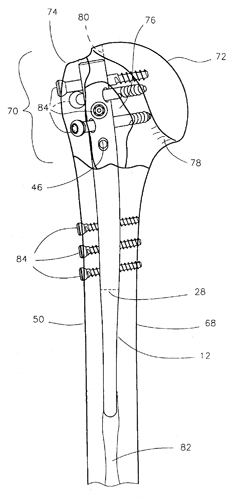
Regarding the balance of the hardships, the District Court was persuaded by Acumed's evidence that Stryker had available a non-infringing alternative (a straight rather than a curved humeral nail), and that Stryker was the world's largest orthopedic implant company (so sales of its infringing humeral nail were only a small portion of its sales, whereas the Acumed nail was its flagship product). The District Court rejected Stryker's argument that a permanent injunction would cause harm to itself, its customers and patients, as well as Stryker's argument that Acumed would benefit from receiving a royalty, since it would gain access to Stryker's "otherwise inaccessible" customers. The Federal Circuit found none of the District Court's reasoning to be error or an abuse of discretion. Stryker's evidence of the expense incurred in designing and marketing were irrelevant to the hardships determination, according to the CAFC, because "[o]ne who elects to build a business on a product found to infringe cannot be heard to complain if an injunction against continuing infringement destroys the business so elected," citing Windsurfing Int'l. Inc. v. AMF, Inc., 782 F.2d 995, 1003 n.12 (Fed. Cir. 1986). The Federal Circuit also found no abuse of discretion in the District Court's determination that Stryker's failure to introduce into the U.S. a straight-nail embodiment of its humeral nail was a business decision that did not tip the balance of hardships in Stryker's favor.

For the fourth factor, the public interest, the District Court found that this factor did not mitigate against the permanent injunction. Stryker argued that its infringing humeral nail was "demonstrably safer and superior" to Acumed's product, citing trial testimony from five expert witnesses. Stryker also contended that Acumed's product had specific deficiencies compared with its infringing product. The District Court found that Stryker had not established "sufficient objective evidence of any public health issue" that would turn the public interest prong of the four-factor test in its favor. The lower court also noted that "there was 'considerable dispute at trial' whether Stryker's evidence was the product of biased experts." Finally, the District Court found that there were non-infringing alternatives to Acumed's product (ironically, the Zimmer and Smith & Nephew licensed products) available to satisfy any portion of the market Acumed was incapable of serving, so that patients would not be harmed by the injunction. The Federal Circuit credited all these decisions as being within the sound discretion of the trial court, and found none of them to be an abuse of discretion.
Perhaps it is the proper role of an appellate court to defer so assiduously to the decisions made by a district court that rely heavily of factual determinations depending on the demeanor and believability of witnesses, live testimony, and trial advocacy relating thereto. And perhaps it has been the tendency of the Federal Circuit in many areas, most notably claim construction, to refuse to so defer, or to provide reasoning supporting its lack of deference (such as its Congressionally-mandated role of providing consistency and harmony to patent law) that makes it appear unusual that the Federal Circuit is so compliant with regard to the district court's assessment and balancing of the evidence in granting the injunction. An inescapable consequence of this compliance, however, is that Federal Circuit also avoids any substantive decision-making in affirming the injunction, based on an abuse of discretion standard it defines as "a clear error of judgment in weighing relevant factors or exercised its discretion based upon an error of law or clearly erroneous factual findings." Using this standard makes it less likely that there will be any readily-reviewable basis for the Supreme Court to grant certiorari in a case like this. Avoiding another opportunity for its jurisprudence to be overruled may be all the justification the CAFC needs to be deferential for a while.
Panel: Circuit Judges Mayer, Lourie, and Gajarsa
Opinion by Circuit Judge Lourie


Leave a Reply