

Earlier this week, the National Eye Institutes (NEI) of the National Institutes of Health announced that it would conduct a study comparing the effectiveness of two Genentech drugs, Lucentis® and Avastin®, for the treatment of age-related macular degeneration (AMD). This was not good news for Genentech, because although treating AMD with Avastin® is an off-label use (Avastin® is approved for treating colon and certain lung cancers), the cost of the treatment is between 1% and 3% of the cost of Lucentis® treatment ($20-60 per dose versus $2,000/dose).

Lucentis® has been a great success for Genentech despite its cost, because it is one of only two FDA approved drugs for treating neovascular or "wet" AMD, a condition that if untreated leads inexorably to blindness. The drug has been so successful that it has the lion’s share of the market over Macugen (sold by EyeTech). The drug has not been without controversy, however, since it is not a cure for AMD but merely stablizes the wet form, and in many patients prevents the condition from worsening. This means that the drug must be administered like insulin or other maintenance drugs. At a cost of $2,000/dose and a once-a-month dosing schedule, the cost to treat the half-million "wet" AMD patients in the U.S. is greater than $10 billion per year. According to Dr. Edward Chaum, Plough Foundation Professor of Ophthalmology, University of Tennessee, this is more than the entire Medicare budget for all of ophthalmology (cataracts, diabetes, glaucoma, and everything else) combined.
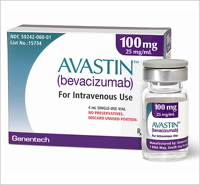
Avastin® is so much cheaper because it is priced at $600/vial for intravenous use, but is injected into the eye at such small doses (0.1cc) that each vial can deliver 30 doses ($20/dose), says Dr. Chaum. Genentech has opposed the off-label use of Avastin®, and cautioned ophthalmologists that there is a greater risk of stroke using Avastin. However, the increased stroke risk was seen at the therapeutic dose for cancer patients, which is 400-fold higher than the dose used to treat AMD. Recently, Genentech also reported that certain doses of Lucentis used for AMD are also associated with an increased risk of stroke.
Not surprisingly, Genentech’s behavior has angered the Retina ophthalmology community, which has generally ignored Genentech’s warnings and has been widely using Avastin® for AMD. The results of the NEI study will not be available for about a year, but the situation should be clarified sooner than that, in view of anecdotal evidence from such off-label use and the expected disclosure of preliminary results.

Dr. Chaum and others believe that the results of the head-to-head clinical trial will likely validate use of Avastin® as being at least equivalent to Lucentis®. If confirmed, Genentech will be forced to choose between removing Avastin® from the marketplace (which is unlikely, since it is a $2 billion/ year drug for cancer indications), or acquiescing to providing the drug in the lower dose amounts that are now provided only by compounding pharmacies.
The hard reality is that AMD is a progressive disease whose best treatment is prevention. It is an indication of the dire consequences of AMD (blindness in old age) that patients and their physicians endure the therapeutic regimen (direct injection into the eye every 4-6 weeks) for drugs that at best only slow disease progression. Genentech lost an opportunity with Avastin® and Lucentis® to solidify ties with a large and growing patient population and their doctors. Perhaps their cooperation, if forthcoming, in the face of the expected equivalence results for these two drugs, and the resulting greater affordability for the majority of patients, can repair the damage.


 Patent Docs
Leave a comment